Showing posts with label Review. Show all posts

Wednesday, December 9, 2020

"I Had a Dinosaur Dream!" - Thoughts on the "Animaniacs" Reboot

Like a lot of people my age, “Animaniacs” was a formative series for me.  It influenced my sense of humor at least as much as it’s contemporaries like “The Simpsons” and “The Far Side”.  I remember so many funny moments and terrific songs.

I also remember “Animaniacs” being wildly inconsistent in quality and tone.  There are some segments where the animation is noticeably worse that it is in other segments, sometimes in the same episode.  And some of the segments are just flat-out duds; I’m thinking mostly of cloying one-offs like “A Gift of Gold”.  But also... (sigh) look, the wildest and least surprising thing I’ve learned recently about the original “Animaniacs” run, something that kind of helps explain a lot of my least favorite reoccurring segments, is that because the show’s creators were no longer beholden to making characters based directly on other characters like in “Tiny Toons”, literally anyone could pitch a new character.  And so we got breakout hits like the Warners and Pinky and the Brain... and we also got things like Hip Hippos and Chicken Boo.  And their segments always gave me that distinctive and uncomfortable “I guess I understand that this is a joke and that it’s supposed to be funny but I don’t get the joke and I’m not laughing” feeling.  (And it’s fine if you liked those characters.  After all, teenage me thought Katie Kaboom was hilarious, mostly because I could not and still can not believe such a blatant metaphor for PMS made it to broadcast.)

So now we have thirteen brand new episodes, and the first taste of what to expect was made specifically for me.  Behold!

This teaser really does set the tone for new “Animaniacs” as a whole.  It is definitely a nostalgia trip, but it's a refreshingly good one.  The animation is much more consistently good and even excellent at times (holy moley the Anime sequence!)  It also trims a lot of fat off the original series; by now you probably know that the Warners and Pinky and the Brain are the only characters from the original series returning with their own full segments (though other characters have cameos).  There are a couple of new characters who appear in one short each.  I can’t help but wonder if this is to test our reaction to them (and in case that is the case, the one Starbox and Cindy short is cute but I don’t know how sustainable the premise is in a show that already has Pinky and the Brain, get the heck rid of the creepy screamy parasitic gnome).

Overall, new “Animaniacs” is very good.  I have a few more scattered thoughts but they might be a little spoilery, so meet me down by the Art of the Day until you watch all the episodes.

-----

* -  I’ve seen some hand-wringing over whether kids will like the new “Animaniacs” or not.  I think they will, especially if they’ve seen the original.  And while they won’t get every joke, who among us can say we got every joke right away back in 93?  Heck, not getting all the references is an old Warner Bros animation tradition.

* - Julia is the best new character hands down, and (again, just in case) I hope to see her again.  She’s a terrific foil for Brain and her design and animation gives me so many good Don Bluth vibes.

* - Speaking of the Brain, I figured he’d have a sad backstory (he is a lab mouse after all), but I never expected it would be THIS sad!  “Learned Helplessness” isn’t a phrase you expect to hear in context in a comedy cartoon, holy sh*t!

* - I don’t remember there being an awful lot of gross-out humor in the original “Animaniacs”, but a few new episodes dip into it here and there.  It’s not to the point where it’s annoying, but that one scene where a character needs her nails done and we get a closeup?  I cried.  Leave that kind of thing to an “Ozzy and Drix” reboot if you must, please and thank you.

* - All told, there are two (2) episodes I flat-out did not like.  I don’t even know what was going on in the episode set in Russia, where the jokes seem frozen in amber since the 80’s.  And the sketch that starts out like "Autotune is bad", then does the “Shakespeare was the Original Rapper” thing, then goes into ten more different directions, is awful and a REALLY really weird sentiment to come from characters born in the 90’s.

* - On the other hand, the Halloween episode is so, so good!  I’m so proud of Wakko; getting over his coulrophobia and tackling the scariest of clowns.  Like and repost if you are also proud of Wakko and his journey.  Well, Like anyway.

-----

Art of the Day!  Time for some fanart why not?
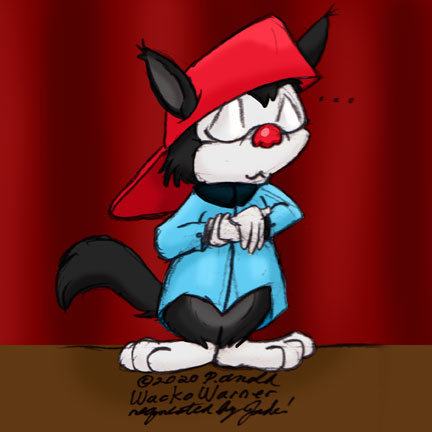
4.10.20 - Six Fanarts Challenge: Wakko Warner

Monday, July 19, 2010

"This One's for the Weird Kids / the Weird Kids of the World" - Thoughts on "Where the Wild Things Are"

I really liked it. Hell, I wanted to give everyone in the movie a hug.

Mind you, I did part of my thesis on Maurice Sendak, so I kind of "get" him. And in saying that, I can see why some people wouldn't like this. It
IS weird. It looks -and, more importantly, it feels- absolutely like a Maurice Sendak illustration in motion. More to the point, and this might be what turned so many people off this movie, it doesn't play by the unspoken rules of what a kid's movie is "supposed" to be these days.

The characters really get hurt and angry and sad. The little boy acts like an actual little boy and throws tantrums when his sister ignores him, bawls openly when his face is accidentally planted in the snow (there are few things worse), and plays under his mom's desk and tells her strange kid-logic stories off the top of his head. He does not act like a snarky miniature adult. He grows and changes but there's no inevitable "and then we all learned a lesson" moment.

It puts a lot of naked emotion on the screen and lets you deal with it on your own. There's no hand-holding and no babysitting. "Where the Wild Things Are" actually reminds me less of any current movie made for children and more of the time, not too long ago, when children's entertainment could be
really weird and offbeat, and could haunt you with questions and ideas and images you suspected, as a child, that even mom and dad couldn't answer or explain for you.

Kids need more movies like this. I watched "Don't You Forget About Me", the documentary about John Hughes and his films, shortly after I watched this and the thing that hit me was something that kept coming up with all the teenagers interviewed for the film: they could not relate in any way at all to what modern-day Hollywood thinks young people are like. The only characters that reminded them of themselves were the ones in Hughes' twenty-something year old movies. Hughes had a knack for writing young people who thought and felt the way adults usually like to pretend they don't really act and feel. That's a rare gift, but I'd say Spike Jones inherits it here.

And, yes, it is a children's film. One that had my entire family enthralled. I say do what our parents did in the '80s: sit your kids in front of it and leave them be. We made out okay, right?

It is freakin' miraculous that this movie exists in the form it does. I haven't even mentioned that it's also absolutely gorgeous and is the one movie out of the many many films I've seen recently that really stuck with me (well, except for the two I'll review over the rest of this week). I could go on, but a lot of my feelings are echoed here.

----

Sketch of the Day!

Here's a Gryphon:

8.25.08 - Thy Gryphon Sketch

Tuesday, June 1, 2010

OK, Let's Talk About That "Lost" Finale.

Now that I've had some time to process everything (and a few things to drink), and you've had at least a week to watch it once or twice, here are my thoughts. Vast galloping herds of unmarked SPOILERS ahead. You've been warned.

I liked it a lot.

I didn't *love* it. I'm having a slight case of "That's not what I would have done!"-ness. (Let us henceforth call this odd sense of fandom-entitlement "The 'Matrix Reloaded' Effect" [though I was fine with that ending too], or even better, based on Neil Gaiman's wonderful essay on the subject, The "George R.R. Martin is not Working for You" Problem). But I really liked it.

Part of the reason why I really liked this finale is simply because it made a lot of people angry. This is a show that never did the expected or "easy" things; characters could be downright unlikeable for large swathes of time, story arcs went down unexpected paths, weird stuff was introduced and never again addressed (there is now a small, steaming crater now where TV Tropes' Big Lipped Alligator Moment page once was.) I will admit, I am human and I would have liked a few more explanations (no, seriously, why were there so many ancient Egyptian things on the Island, what the hell was going on with Walt, and just what the heck *was* Smokey?) A lot of people said they feel as though the writers screwed them over by not addressing many of the stranger plot twists and have even started to resent the series as a whole. (Seriously. Take a shot when you run into a comment like, "They didn't address my pet mystery so now the whole series that I have been 100% on board with for longer than most people spend in college sucks and we hates if forevers!") My thinking is, if "screwed over" means six years of terrific television with smart science fiction and some of the best characters I've ever had the pleasure to meet, then I would like to get screwed more often.

That came out wrong... O.o

I like how some people will be debating those final ten minutes for weeks. I like how those final ten minutes are destined to be misinterpreted -- even though, and I don't mean to insult anyone, if you didn't understand what was actually going on there, I am in no position to help you. (Tellingly, a LOT of negative comments online are from people who just watched this last episode out of curiosity or otherwise didn't pay much attention to the series as a whole. It's pretty much your own darn fault for not liking it.) I've been on this ride since season two (my curiosity about the series was piqued when I saw the late, lamented "Best Week Ever" summarize the season finale), and I'm going to miss my weekly visits to The Island.

Listen, I was doing fine until around the twenty-five minute mark. Then it got really dusty...

(Oh, by the way, I totally called it. In a manner of speaking.)

----

Sketch of the Day! This has nothing to do with "Lost", but it's still funny.

"Fun in the Backyard" Episode 43

Monday, December 7, 2009

When you see the terrier, drink! Let's Read Six by Van Allsburg!

I made some art! I went for weeks without making art and it felt weird! Now I feel better! More (and the bigger version of this painting) at Flickr.
641. Halcyon Snow
OK, last week the "long stuff on the usual days, quickies on the other days" pattern didn't work out so well. So I'm going back to my good old M/W/F schedule.
For today, it's the Picture Book Analysis project I mentioned way back in October. I saved it until now because now it is December. Which means it's almost Christmas. Which means it's almost time to read The Polar Express with a cup of cocoa.

Originally "published" 3/24/05.

Jumangi
Written and Illustrated by Chris Van Allsburg
For the Picture Book Analysis Project, I have chosen to review the works of author/illustrator Chris Van Allsburg. I will be considering the six books in chronological order. In this way, I will be able to review Van Allsburg's growth as a writer and artist.
Amazingly, Jumangi is only the second book Chris Van Allsburg wrote and illustrated. Already he shows an incredible eye for detail and atmosphere in his illustrations, rendered in black and white conté (a charcoal derivative). The lack of color creates an ominous, dreamlike mood. The illustrations are on single pages, facing blocks of text. This gives the story an even pace even as the tension mounts in the written text. The use of borders around the illustrations enhances the dreamlike effect, as if we're peering through windows into another world.
Van Allsburg's writing is often accused of being boring compared to his illustrations, which is a rather unfair comparison. In Jumangi, the text is mainly used to enhance the story told in the illustrations. Van Allsburg uses it to further the plotline, describing characters and events that aren't shown in the pictures.
This has turned out to be an important thread working throughout Van Allsburg's books. His illustrations are very detailed, but his books still rely strongly on the reader's ability to use her imagination. For this reason, and the fact that his stories tend to be subversively frightening at times, his books are better for students aged seven and above. Jumangi works well as a read-aloud and as an independent reader. As a read-aloud, children are compelled by the exciting story. As an independent reader, they have a chance to study Van Allsburg's meticulous artwork firsthand.

The Mysteries of Harris Burdick
Written and Illustrated by Chris Van Allsburg
The Mysteries of Harris Burdick is my single favorite Chris Van Allsburg book, and that's saying a lot.
There is no story. Just a collection of fourteen stunning Van Allsburg illustrations, each accompanied by a title and a short line of text. It's as if the artist has chosen to boil down his storytelling skill to its very essence. Van Allsburg's writing is often accused of being rather dull and redundant when compared to his evocative artwork. He usually uses text only to further the plot along and describe elements of the story that aren't contained in the illustrations.
In Mysteries, aside from a brief introduction crediting the drawings to a mystery artist, there are less than two hundred words of body text. Therefore, almost all the storytelling is done within the illustrations. In the mere three years between Jumangi and Mysteries, the increases in Van Allsburg's skill with conté and his confidence in his gift are nothing short of extraordinary. The black and white illustrations show incredible depth and detail, and the imagination they show is breathtaking.
Once again, this is a book that trusts the reader's ability to use her imagination. However, reading Mysteries is clearly a solo experience. It is perhaps best appreciated as an independent reader for older students. They have a chance to study the illustrations, but they also have an opportunity to expand on the stories within the drawings. While the artwork can be enjoyed on its own merits, any one of the pictures can be taken as a wonderful starting place for a creative writing project.

The Polar Express
Written and Illustrated by Chris Van Allsburg
Here is Chris Van Allsburg's signature book. Within a decade of its publication, The Polar Express had already established itself as a holiday classic. Not surprisingly, I know many fans (myself included) who read this book on an annual basis: on Christmas Eve, accompanied by a mug of hot cocoa.
Polar Express is one of Van Allsburg's few works featuring color. He has switched from his favorite medium of conté crayon to chalk pastels. Once again, his confidence in his abilities as an artist is increasing. The absence of color in his earlier works gave the books a mysterious, dreamlike quality. The addition of the element of color creates more realism. The first and final illustrations in the book are nearly photorealistic, while the remaining illustrations, with their fantastic settings and characters, are made more surreal. Perhaps Van Allsburg made the artistic decision to use color in order to increase the believability of Santa's workshop. (Of course, there's still the artist's trademark ominous air. The North Pole could be mistaken for an industrial park, were it not for the elves and cheerful twinkling lights, and Santa Claus would be hardly recognizable without his distinctive red suit.)
Furthermore, the formatting in Polar Express is highly unusual for a Van Allsburg book. I like to think of the illustrations as "letterboxed"; they're bordered double-page spreads with a bit of room set aside on either the far left or far right for a few paragraphs of text. Once again, Van Allsburg makes it very clear that the illustrations are, so to speak, the stars of the book. The text is simply a supporting player.
The Polar Express is very moving for older readers, reading independently. It is also a compelling read-aloud for much younger children, and is perfectly fine for first graders.
Just make sure you get to them before somebody decides to subject them to the movie.

The Widow's Broom
Written and Illustrated by Chris Van Allsburg
This is an unusual work from Chris Van Allsburg. In the three books I have studied so far, the text supports his illustrations. The illustrations are clearly the stars of the books. However, in The Widow's Broom, the text is on equal footing with the visual elements of the book. Broom was published in 1992, almost a full decade since Jumangi. In that time, we've seen Van Allsburg's skill as a visual storyteller increase dramatically. But now, we finally see an increase in his confidence as a literal storyteller.
The illustrations in Broom are, naturally, still fantastic. Once again, they are conté crayon, black and white, and highly atmospheric. Most of the illustrations are single-page pieces facing the text, but there are a few double-page spreads. These explain parts of the story that wouldn't come across as easily in the text, and as we've seen in most Van Allsburg books, quite the opposite is usually true.
I described The Polar Express illustrations as bringing to mind a letterboxed (wide-screen) movie. This time, the format is noticeably tall instead of long, which is very unique (the visual cortex is wired for horizontal compositions; this is why you almost never see films -or books- formatted in "tall-screen"). This layout serves the text more readily than the illustrations, emphasizing the fact that the text is the star this time out.
The Widow's Broom is a touching tale about the cruelty of intolerance. With that said, it's best used as a read-aloud for second-grade and above, and would be a fine book to discuss afterward.

The Sweetest Fig
Written and Illustrated by Chris Van Allsburg
Published one year after The Widow's Broom, The Sweetest Fig is sort of a return to form for Chris Van Allsburg. Once again, the text is less prominent than the illustrations. The storyline is amusing, but not as memorable as the four books I've analyzed so far. To be honest, it's one of his weaker efforts.
But even a comparatively boring Van Allsburg has more interesting things going on in any given illustration than some novels have in their entire length.
The Sweetest Fig is only the second book in this study where Van Allsburg has used color. It appears that the drawings are rendered in chalk pastels, as in The Polar Express. Color is used in a very different way this time. In Polar Express, the colors were very vivid, but in this book they are subdued. In fact, most of the illustrations barely appear to have any color in them at all, except for one or two elements such as the titular figs, and they immediately command attention as a result.
The formatting is also similar to that of The Polar Express. They're bordered double-page spreads with a bit of room set aside for a paragraph or two of text. This time, the text only has a tiny white square set aside for it.
The Sweetest Fig is not one of Chris Van Allsburg's masterpieces, but it could be a fun read-aloud for younger children. They will especially enjoy the magical justice served to the nasty main character by his long-suffering dog.

Bad Day at Riverbend
Written and Illustrated by Chris Van Allsburg
This one is another personal favorite of mine. With that said, I have a hard time ruining the surprise ending, as it is one of my favorite aspects of the book. I will try to make this a spoiler-free analysis.
Bad Day At Riverbend is at once obviously unlike anything Chris Van Allsburg has ever done before. It's almost unrecognizable as one of his works. In this book, for reasons that are integral to the plot, he has switched from his favorite medium of conté and pastels to pen, ink, and wax crayon. The illustrations are stark, simple outlines. He returns to his usual drawing style only in the final pages of the book.
The formatting in Riverbend is also unlike any other Van Allsburg book, because the text finally gets to share visual space with the illustrations, without being blocked in by borders or stuck on a facing page. The illustrations are all double-page spreads, and there are no borders at all until the very last page.
Just how distinct is this from any other Van Allsburg book? Well, this is the only book in this entire report where I wasn't able to find the trademark bull terrier he always seems to be able to sneak in.
I have a hard time imagining this kind of book working as a read-aloud, and I don’t know if very young children would understand the ending. Because of its high-concept story, Bad Day at Riverbend is probably best enjoyed by older children reading by themselves (the closest relative this book has is clearly David Wiesner's The Three Pigs). The reality of the "bad day", and its revelation, is ingenious.
----

I'll be talking about Christmas movies and specials in the near-future. Until then, why not enjoy the best turkeys of the past decade, care of The Onion AV Club?

I haven't yet seen "The Happening" or "The Wicker Man", and I don't know if I could bring myself to sit through "Battlefield Earth", but I have seen "D Wars" and it is as awesomely insane as it sounds. So OK, ratbrains, which of these movies do you secretly like?

Friday, October 16, 2009

Let's continue reading my essay on Maurice Sendak!

Ow, my thumbnails. And pretty much everything else. I may have gone a little overboard gardening yesterday.
Anyway, the second half of this essay (here's Part One) is made up mainly of book reviews (for the record, I was required to consider whether each book was appropriate for a school classroom) and a brief summary of the author's biography and Bibliography:

The Sign on Rosie's Door, Written and Illustrated By Maurice Sendak
As in the Picture Book Analysis Project*, I will be considering these eight books in chronological order. In this way, I will be able to review Maurice Sendak's growth as a writer and artist.
The Sign on Rosie's Door is the thirty-ninth book illustrated by Maurice Sendak. However, it is only the third book that Sendak himself wrote, based upon his own original ideas. The story is about an imaginative little girl whom Sendak has since identified as an amalgamation of several children he'd known in real life in his Brooklyn neighborhood. Like her real-life counterparts, Rosie is a born actress with a wildly creative imagination. She has a talent for bringing other children into her fantasy role-playing and refuses to break character for anyone, even if the play is interrupted.
This is a book that celebrates a child's ability to use her imagination. Rosie is the typical Maurice Sendak child-hero. She's spunky, artistic, and not always appreciated by adults and less imaginative children. Her story is both hilarious and achingly ironic (the ending of the first chapter is a great combination of humor and pathos).
The illustrations are charming and energetic. We feel like we know these children, as their faces and gestures convey a great deal of personality. Sendak's style of illustration in this book tends to be less concerned with realistic detail and more with animation and characterization.
Sendak's books are almost always better for older children, but Rosie is appropriate for all ages. Overall the book feels like an episode of an animated series (one can easily imagine the further adventures of Rosie and her friends). As it happens, Rosie and the four little books of the Nutshell Library formed the framework for the animated feature "Really Rosie", one of Sendak's disappointingly rare excursions into film.
* - I had to review a series of picture books by one illustrator in chronological order. I'll have that up sometime later, possibly December. (You'll see why when you see who that illustrator is.)

Where the Wild Things Are, Written and Illustrated By Maurice Sendak
Here is Maurice Sendak's signature book. Wild Things caused a sensation when it was first released in 1963. It would go on to win the Caldecott Medal, and it is today regarded as a classic of its genera.
However, it is also a book that tends to make adults anxious. Are the titular monsters too scary? For some children, especially very young ones, they could be. You might not want to read this as a bedtime story to a preschooler. However, it's wonderful as an energetic read-aloud for second-graders and other children around the age of the hero, Max. You'll notice, in the book, how Max finds the Wild Things more comical than menacing.
In fact, Sendak has recently explained that his inspirations for the Wild Things are none other than his older relatives. More specifically, they are caricatures of how he saw them as a little kid.
The pen and ink and watercolor artwork in Wild Things is evocative, and once again brings to mind a particularly lavish animated film. Much has been said about Sendak's creative use of borders and of blank, white space. As Max travels to and from the world of the Wild Things, the images grow until they fill the page, and then shrink back down again.
It took Maurice Sendak quite some time working on the story of Wild Things before he finally decided he'd got it right. The language of the text is understated and adds to the dreamlike quality of the images. There is great humor in the story and a sense of fun, and above all Sendak respects the child's ability to use his imagination.

Hector Protector and As I Went Over the Water, Written and Illustrated By Maurice Sendak
This book contains two obscure Mother Goose rhymes illustrated by Maurice Sendak. He hasn’t changed the rhymes at all, but he has expanded considerably on their plot. The illustrations are once again pen and ink and watercolor and very animated.
Hector Protector, in Sendak’s version, is a little boy who’d probably rather be outside playing but instead has to get dressed up nicely and deliver a cake to the Queen. He protests this unspeakable injustice by screaming “no!” repeatedly, and drop-kicking the cake the moment he’s outside. After encounters with a lion (who may have wandered in from the island of the Wild Things), and a boa constrictor, our hero makes a truly memorable appearance in the Queen’s court.
In the second story, “As I Went Over the Water”, another little boy sails about in a ship that is swallowed by a rather silly looking sea monster. The boy heads to an island where he meets two accusatory birds. After taming them in a fit of violence, the boy heads back into his boat (recently regurgitated by the monster) and makes the repentant animals his skippers.
It’s obvious that Sendak had much more fun expanding on “Hector” than “Water”. The first story is so hilarious and memorable that the second pales in comparison. It’s hard to say how this book could be used in a classroom, but it’s fine for older students to read by themselves.

Higglety Pigglety POP! Or There Must Be More to Life…, Written and Illustrated By Maurice Sendak
1967 was a very hard year for Maurice Sendak. His mother had fallen very ill. While on a trip to England, he had a severe coronary attack. After recovering from his near-death experience, Sendak returned home to find that his beloved terrier, Jennie, was suffering from cancer. Higglety Pigglety POP! was published less than a month after Jennie died.
This book is a love letter to a dear, lost friend. It is illustrated in loving, intimate pen and ink drawings that simulate the look of Dürer engravings. Many of these drawings are based directly off of photographs Sendak had taken of Jennie.
The story is an engaging modern fairy tale. Our furry heroine heads off on a voyage to find her destiny, meeting a series of unusual characters along the way. (They are also very patient characters. For example, the first living thing Jennie converses with is a potted geranium who accepts Jennie's appetite, her most prominent personality trait. The plant does not complain as the dog rapidly eats off all its leaves.) Jennie lives happily ever after, safe and loved in a mysterious castle that no one can quite remember the directions to.
This book can be enjoyed by children of any age. However, it is perhaps most profoundly moving for older readers. It should be noted that the book is actually quite humorous in tone and its underlying themes of loss and remembrance are kept very subtle. Perhaps there aren’t many young children who could understand the subtexts. But you never know with some children, so I wouldn't use this in a classroom if I knew that a student had just recently lost a pet.

In the Night Kitchen, Written and Illustrated By Maurice Sendak
Bizarre, unique, and ultimately unforgettable, this book is one of Sendak's personal favorites. Night Kitchen contains a wealth of pop-culture cross-references, and it is a celebration of everything Sendak remembered well from his childhood.
The hero, Mickey (named after Mickey Mouse of course) has a very strange dreamlike adventure in a realm where three fat, happy bakers bake cakes all night long. The story is inarguably weird. It works, however, because the text is bold and brassy and has the feel of an old nonsense-rhyme.
The artwork is colorful and energetic. It is straight out of a Windsor McKay comic illustration, and is packed with wonderful details and inside jokes.
With all that said, this book might not be for all people.
All of Sendak's books have a dreamlike quality, but this one actually takes place within a characters' dream. That means that the story doesn't use the same logic that more normal stories do. This could be a little much for the classroom. Not to mention the fact that Mickey is unabashedly naked for most of the story. It's hard to say how In the Night Kitchen would fit in a classroom, but it is worth reading. The book is a hallmark of Sendak's career and it was made into a delightful animated short film by surrealist director Gene Deitch.

Some Swell Pup! Or Are You Sure You Want a Dog? Written By Maurice Sendak and Matthew Margolis and Illustrated By Maurice Sendak
Two little children, a boy and a girl, sit in the windows of their playhouse longing for a puppy. A mysterious stranger (who happens to be an anthropomorphic dog) overhears them and drops an adorable puppy on their doorstep. The children are overjoyed by their good fortune.
Their new puppy proceeds to urinate on their carpet.
The puppy then goes on to maul the upholstery, defecate on the floor, and generally trash the playhouse. So Maurice Sendak, with the help of Matthew Margolis, the director of the National Institute of Dog Training, has created an unflinching, warts-and-all guidebook about the reality of raising a puppy. His use of comic book style art and formatting adds much-needed humor to the mayhem. He makes it very clear that pets can be a handful sometimes. Yes, it is funny when the puppy pees on the floor... but guess who’s going to have to clean up afterwards? This is a book that faces issues up front that very few children’s books are willing to acknowledge.
But Sendak has faith in the fact that having a pet is well worth the effort. The love is rewarding. In the end, the children accept their new responsibilities. This book is an excellent resource for parents who want to discuss with their children exactly what to expect after bringing a pet into the house.

Outside, Over There, Written and Illustrated By Maurice Sendak
This is perhaps the best of Maurice Sendak's more recent books. It is an eerie modern-day fairy tale based upon a wide variety of elements that had been floating around in its creator's unconsciousness for decades.
Ida, the greatest Sendak heroine since Rosie, takes her eyes off her baby sister for a split second, and in that second the baby is snatched away by mysterious, cloaked goblins. Furious, Ida immediately sets out into the weird demon playground of the title in search of her sister. She finds an ingenious way to defeat the creatures and returns with baby… and her mother and father have no idea of her dangerous adventure.
Visually, this book contains the most astonishing artwork Sendak has ever produced. The colors are intense and reflect Ida's changing moods. The bizarre other world of the goblins is as strange and scary as a horror movie. In fact the book is without question too frightening for small children (and unnerving for adults as well; the eyes on the ice doll the goblins replace the baby with will haunt you for days).
The story is exciting and the writing is offbeat and poetic. It follows the strange logic of folktales, and Sendak isn't shy about putting his characters through serious danger. Sendak has since hinted that each of the characters and events in the story has a real-life counterpart from his childhood in the 1930's. Ida could be Sendak's older sister. Baby could be the kidnapped Lindbergh baby, and the entire story could have been sparked by Sendak's horror about the case and its outcome. The goblins might be caricatures of the Dionne quintuplets, there is a cameo from Mozart, and the ironic ending is clearly inspired by "the Wizard of OZ". While not as familiar as Where the Wild Things Are, Outside, Over There is a masterpiece.

We Are All in the Dumps With Jack and Guy, Written and Illustrated By Maurice Sendak
This is easily the strangest Maurice Sendak book of all and that's saying a lot.
Dumps is fairly recent, published in 1993, and is one of the last of Sendak's books to receive significant attention in the mainstream press. It is about as far removed from Sendak's previous nursery rhyme books (such as Hector Protector) as you could possibly get. Instead of happy and funny, this is rather downbeat and more than a little disturbing.
Here's the story. In the first rhyme, a group of orphans live by themselves in a little shack. They are tormented by nasty, scary-looking ratlike monsters who kidnap a huge litter of kittens and a tiny baby. The story continues into the next rhyme, where two of the orphans, Jack and Guy, rescue the baby and the kittens with the help of the ever-present and increasingly angry moon.
This book is bleak, even though the story ends happily. All of the environments are dirty alleyways, smog-belching factories, and overgrown ditches. The bad monsters are terrifying and the helpful moon isn't any less scary. I like Sendak, but this book was a bit too much.
It isn't hard to see why this book gained notoriety. It pushes a lot of thematic buttons. It is very difficult to decide who out there would enjoy a book like this and I haven't the slightest idea what you could do with it with children in a classroom. Nonetheless, it is so unusual that it is worth it for adults to read.

Biography
* - Born Maurice Bernard Sendak on June 10, 1928 in Brooklyn, New York;
* - Parents were first generation Polish immigrants;
* - Sendak never enjoyed good health as a child. He entertained himself by making up stories with his older brother and drawing pictures to go along with them;
* - Took inspiration from the daily life of the city around him;
* - Sendak’s art is most profoundly influenced by Disney films and Windsor McKay comics;
* - Sendak’s books never speak down to children. He celebrates childrens’ use of imagination and love of fantasy;

Books and Films

Books Maurice Sendak wrote and illustrated himself (selected):
Kenny’s Window, Harper, 1956
Very Far Away, Harper, 1957
The Sign on Rosie’s Door, Harper, 1960
The Nutshell Library, Harper, 1962
Where the Wild Things Are, Harper, 1963
Hector Protector and As I Went Over the Water, Harper, 1965
Higglety, Pigglety, POP! -or- There Must Be More to Life, Harper, 1967
In the Night Kitchen, Harper, 1970
Some Swell Pup -or- Are You Sure You Want a Dog? Farrar, Straus, 1976
Seven Little Monsters, Harper, 1977
Outside, Over There, Harper, 1981
We Are All in the Dumps With Jack and Guy, HarperCollins, 1993

Selected books Maurice Sendak illustrated for other authors (starred writers are frequent collaborators, so to speak):
* Ruth Krauss, A Hole is To Dig, Harper, 1952
* Else Minarik, Little Bear, Harper, 1957
Hans Christian Anderson, Seven Tales, Harper, 1959
* Randall Jarrell, The Bat-Poet, Collier, 1964
Isaac Bashevis Singer, Zlateh the Goat and Other Stories, Harper, 1966
George Macdonald, The Golden Key, Harper, 1967 (currently published by Farrar, Straus)
Frank Stockton, The Griffin and the Minor Cannon, Collins, 1968
* the Brothers Grimm, The Juniper Tree and Other Tales from Grimm, Farrar, Straus, 1973
E.T.A. Hoffman, The Nutcracker, Crown, 1984

Filmography:
Maurice Sendak’s only director credit (so far) is the animated film, “Maurice Sendak’s *Really Rosie*”. However, a feature film was made of “the Nutcracker” with sets and costumes based upon his designs. Surrealistic animator Gene Deitch made a delightful short film adaptation of “In the Night Kitchen” which is well worth hunting for. It and “Rosie” have been released on home video by Weston Woods. Both Little Bear and Seven Little Monsters have been adapted into ongoing animated series.

Online Resources
Curiously, Maurice Sendak doesn’t appear to have his own official website. His publishers have very brief information to share. Here are their websites:
Harper Collins
Hyperion Books

----

The main reason why I was moved to publish this online is because it seemed last week as though someone had cried out, "Let the 'Where The Wild Things Are' backlash begin!"
Listen, Maurice Sendak says he loves the hell out of the film*, and that's enough for me. And it turns out that the few people who have seen "Wild Things" and disliked it have also admitted a dislike for the thematically very similar "My Neighbor Totoro". Apparently, the slow and whimsy-heavy pacing of "Wild Things" is very Miyazakian.
They act like that's a bad thing in a movie for kids.

* - He very succinctly shares his opinion on an issue I brought up earlier: "The controversial content of the book hardly bothered anyone, but for some reason now that it's a movie everybody panics. WTF?"

Boston Comic-Con is a week from tomorrow! I'll be there, of course, at the Comic Artists Guild table, and as of right now I am scheduled for mid-day both Saturday and Sunday. Come by and pick up a promotional postcard!

And if you live in New York City, you can go see some at WizardWorld this weekend!

And I'm very glad that ToughPigs recently posted a blog about this television special which, as you'll see, was so strange I thought I dreamed it.

Friday, October 2, 2009

Megafauna's Back Baby! Let's Continue Reading _After Man_!

We're taking a tour of Dougal Dixon's classic sci-fi biology book, After Man, A Zoology of the Future, which envisions a world fifty million years after all modern large animals go extinct. Read the first half here.

Now, as I said before, this book was published in 1981, and it's animals were probably invented long before that. The science is a little dubious when seen through modern eyes, but for the most part, the artwork is still very good and most of the fictional animals are just plain cool-looking.


I said MOST of them!

Illustrations by Diz Wallace. Now, this wouldn't be a book review by me if I didn't point out a few weird and or... unpretty creature designs. The shrew-descended Tree-Drummer and Reedstilt (like the infamous Wyrm) don't really make any damn sense unless there are absolutely no animals more qualified to fill these niches. There
are tree-boring birds and long-necked fish-eating birds in the world of After Man so...


Illustration by Diz Wallace. As I said in the previous post, we can't play the Dixon Drinking Game unless we change the rules a little, as there are very few animals who sport rolls of fat. Here are the Turmis, a kind of pig-elephant, and they will be your unlikely ant-eating species for this evening.


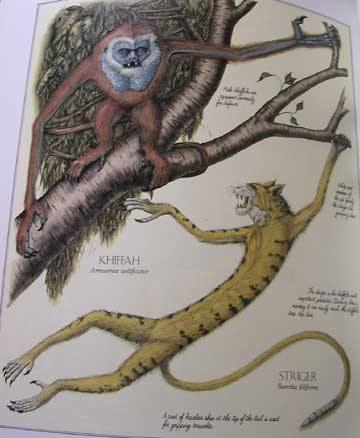
The happy fellow in the upper-right of this illustration (once again by Diz Wallace) is the Khiffa, and he and his colony will be your unlikely colony-dwelling species for the evening.
 

And dig the Striger; a creepily anthropomorphic climbing cat.


The Tusked Mole is the first of a few animals whose lifestyle might not have been thought out all that well. I would have thought tusks that stick straight out of your face would get in your way while digging.


The Night Glider is similar in that respect. It's essentially a predatory flying squirrel, dropping silently on it's prey from the 'bove (A). Unfortunately, gliding animals can't really fly without a leaping start and cooperative winds, so I'm not sure what the Glider's supposed to do with it's prey after succeeding in securing it (B).


And now, the saddest imaginary animal ever.


Illustration by Diz Wallace again. Man, how did
that conversation go? "You want me to draw the saddest imaginary animal ever? OK!" 

The Slobber is a creature that does exactly what you see her (yes, her; that thing clinging to her stomach that looks more like it's sticking out of it is her baby) doing all day long: catching insects with her drool. This is not a pretty mental image.

And then, there is the infamous Parashrew:


I have nothing at all to add to this, so bring on the Giant Penguin-Whales!!!


Diz Wallace yet again. "WHAT?!?"


Hell, I love the Pelagornids and the Parashrew. The sheer ridiculousness of these animals is impressive. For one thing, I've seen the B.S. penguins need to deal with every spring. You gotta figure that if penguins were ever going to develop the ability to bear live young instead of laying eggs, they'd have done so by now. I also like the fact that a whale-penguin is right out of "Avatar: the Last Airbender".


I can be as sarcastic as I like, but
After Man is a classic of it's genre. It has had a lasting influence on myself and anyone else who has ever wondered "what if?"

Plus it kicks the stuffing out of "The Future is WAAAY Too Trippy Wild".

----

Totally unrelated, but you may have started to see the TV spot for "The Princess and the Frog" last week. If not, it looks like this, but shorter (embedding is disabled). Now... I'm on good authority that the full film is better than this looks, and I desperately want the film to be better than this looks (it's absurdly unfair that so much should be riding on this one film). But is anyone else getting a nasty "Rock-A-Doodle" vibe from this teaser?

Wednesday, September 30, 2009

The Humans Are Dead, But There Are Jackalopes Now! Let's Read _After Man_!


I'll warn you right away, my nostalgia filter may be strong with this one. Indeed, you may run into many science fiction fans / armchair biologists / creature designers / ect. around my age whose young minds were permanently blown by Dougal Dixon's After Man. The New Dinosaurs, in hindsight,
might actually be better, but I find it very hard to have many bad things to say about After Man and it's various creatures. As the delightfully named Caustic Cover Critic says, the book is "deeply odd and quite fascinating."

After Man
was first published in 1981 (and the creatures were likely invented well before that, so take the science with a grain of salt), but I first learned about it through one of the Museum of Science's stranger traveling exhibitions. It was called "Future Zoo" and it was essentially a walk-through version of the book, with paintings on display, sculptures and animations of the animals, and even a robotic Desert Leaper (a la those wonderful traveling robotic dinosaur exhibits). Sadly, there does not appear to be any information about it online, so I have to go by my foggy memories. The exhibit was really the first work of hard science fiction that spoke to me as a child, and once I learned there was a book I HAD to have it.

Flash-forward nearly
ten, maybe even fifteen years to the frabjous day when I spot this, totally randomly, in a random gift shop:


Now of course I bought this on the spot. All told, I've only seen two copies of this book in person. Sadly, they were both incredibly cheaply bound softcovers. Before I start giving you the tour through the book and post more pictures, I need to show you what condition my copy is in now:


Illustration by Gary Marsh. Talk about loved to death. Long out of print, Dixon's books are notoriously hard to find nowadays and known copies tend to be expensive. Here's the Amazon link if you'd like to try your luck.
 

Anyway, the introduction of the book serves mainly as a refresher course of basic evolutionary biology. It also reminds us that many of the animals around today had ancestors that would be completely unrecognizable to us.
 

This will prove to be foreshadowing, as the world in After Man is one that had been long ago inherited by the meek. As the title suggests, the humans are dead. So are all the other animals human-sized and larger. The world is very different now, after all the large animals went extinct fifty-millions years ago in the early 1980's.
 

This kind of thing comes with the territory of setting a book in the future. Just go with it.
But with that said, you have to remind yourself what most science fiction dealing with future evolution was like prior to
After Man. Typical scenarios include things like, "humans will keep getting smarter and smarter but they will also have terrible powers and be evil!" "There will be all kinds of giant monsters with big teeth and claws and blah!" And the good old chestnut, "radiation will cause normally innocuous animals to mutate and try to kill everyone!" Come to think of it, that last one is still around in full force; just replace "radiation" with "genetic engineering" (or, frankly, "writers who failed biology").
 

That's why After Man was so refreshing. It was also the first time many of us saw imagined animals treated with utmost respect and painted as if they were real. Here's one of the first illustrations in the book, introducing two major groups of future animals, the Rabbuck and Predator Rats, and it's still awesome:


Illustration by Diz Wallace, affectionately parodied here. This is how you illustrate creatures that don't exist. (Though it is a huge missed opportunity that the Rabbucks are not actually called jackalopes.) I wouldn't be surprised to see this exact scene in a real Victorian-era natural history book.


Illustration by Philip Hood. We've met two of the three major groups of animals in the previous illustration (the Rabbucks are large deer-like animals descended from rabbits and the Predator Rats are... exactly what it sounds like.) These Hornheads are in the third group, the Gigantelopes. Only the very small hoofed mammals like caprids survived into the future. I just like these guys because I have a soft spot for moose, sheep, and hadrosaurs.


Illustration by Philip Hood. Here's the lovely Desert Leaper, essentially a gigantic jerboa who has filled the niche left wide open by the camels. For those of you playing the Dougal Dixon drinking game, note that this guy is one of maybe three animals in the book that displays (ahem)...


Now let's meet the fellow alluded to in the beginning, Nightmare Fuel on Legs the Night Stalker, a predatory flightless bat.


Illustration by Diz Wallace. This illustration found it's way into several other sci-fi books and (subconsciously at least) into a number of character designs.
 

Gosh, this is already getting to be longer than I expected. Let's stop here and meet more of the animals in Part Two.
 

And here's the old Tetrapod Zoology post that got me thinking about Dixon's books again.
 

And, hey, it's Banned Books Week! I'm sure After Man has been challenged at one point or other. Or it would be if it were less obscure - which is one of the things about the Challenged Book List that gets me. (It seems a book isn't controversial until it gets popular or attention in the mainstream media. Note that it took a while for His Dark Materials to crack the top ten.)
 

And for the love of Benji, people. They're PENGUINS. (But I'm suddenly curious to know how, exactly, these penguins are also "anti-ethnic". WTF?!)

Friday, July 17, 2009

Let's Read Every Harry Potter Novel in a Row!

A repost from my old MySpace blog.
I was unable to attend the release party at Harvard Square for Deathly Hallows (I was there entirely by accident for the
Halfblood Prince release and to this day it remains one of the times I most regret not having a camera on me.) So instead, I decided to build myself up to reading the last Harry Potter novel by reading every piece of literature related to the saga I happened to have with me.
Originally posted 6/29/07.


I'm glad I did this. Not only was I able to appreciate for the first time how much deeper this series is than most people appreciate, I was also more able to appreciate the scope of the final novel (which gets it's own spoilerrific post after this one). And since I'm crazy and have a bit of a self-indulgent streak, here's the play-by-play:

Day One (July 14): Harry Potter and the Philosopher's Stone
Thoughts from the very first chapters:
* - Harry ain't gonna die. If he does, I will -er- do something silly.
* - I'd forgotten how Roald Dahl-esque the series really is.
* - Raise a pack of Lemonheads for Albus. <:( * - Already with the spiders! And she's introduced Sirius and Miss Figg too! J.K. loves her foreshadowing. * - Note the obsession with food. And Draco is already a racist little sh*t. And did Scabbers just save Ron? * - Snape is definitely on the Chaotic Good side. No doubt. (Maybe a little.) * - I'm a bit worried that we really may be headed for an irony-soaked, very confusing ending a la "Fullmetal Alchemist"... This is probably the longest I've ever taken to read a book I have already read before. It's a hell of a lot better than I remember.

Day Two (July 15):
Harry Potter and the Chamber of Secrets
I've always been a bit lackluster about this particular book. But it is supposed to be one of the most important from a plot-building stance. It is better than I thought, but it does play out like "Harry and the Attack of the Foreshadowing". If nothing else, it's cool to notice that she introduces Mundungus here.
Incidentally, I do not buy the argument at all that the saga has gone "dark" (whatever that means) only in the last three or four books. There's some heavy stuff going down already here in Book Two. (Moaning Myrtle is just an overall creepy character. There's also giant man-eating spiders and Dobby's self-flagellation.) Whatever, it's time for Book Three which is the point where I first admitted we were reading something special.

Day Three (July 16): Harry Potter and the Prisoner of Azkaban
This is the one that got me hooked. Not much else to say there.

Day Four and Five (July 17 and 18): Harry Potter and the Goblet of Fire
The first of The Bricks. I got way too much sun reading outside on Day Four so fortunately it rained on Day Five. You'll notice I was cutting it very close to Release Day, so I had to remind myself that I was about as isolated as I could get, I'm not really an obsessed Person of Fandom who needs to know how the saga ends right away, and basically I can take my time if I want. Still, it bothers me a lot when it takes a great deal longer than expected for me to read a book I have already read before.
Fortunately, I got to the ending of Book Four by the end of the day. Fans call this the "Empire Strikes Back" part of the Potter saga. I call chapters 32-35 the "Holy Sh*t" scene. I'm sure it inspired more than a few nightmares. And thank goodness for that. Really. It's so much easier to tone a villain down these days. It's actually a lot more satisfying to have a villain who really is evil, therefore the hero's conflict is far more tense.
In other words, I take back all the detracting things I have said about the saga over the years. Aww.
(Well, almost all of them.)
I topped off the night with the two little interlude-like "Textbooks" (
Magical Beasts and Quidditch Through the Ages). World-building is fun.

Day Six and Seven (July 19 and 20): Hary Potter and the Order of the Pheonix
I finally finished the 870 glorious pages of Book Five on Release Day! Reading this book at a leisurely pace is a fine reminder of just how damn long it is. I remember blitzing through it the first day I got it. Not a good idea. There is a metric buttload of information to digest here. All I can say is that if bacon and Crumple-Horned Snorkacks do not figure into the finale somehow, I will be sad.

Day Eight and Nine (July 21 and 22): Harry Potter and the Halfblood Prince
Joy and rapture, I received my package from Amazon at 11:00 AM on Day Eight. While waiting, I read Book Six. Basically, this book, while good, is "Fast Times at Hogwarts School", juxtaposed with a massive amount of exposition and topped off with a tragic ending. At this point, I felt like I was vacationing with the characters.

So.
So there I was ready to read the final book in the Harry Potter saga. At once, I was excited to see how she'd wrap everything up and rather bummed to see the story end.
Thing is, as a fantastic fiction fan, I've been in this situation before. Lord knows how the eleven-year-old fans are feeling.
My reactions to Harry Potter and the Deathly Hallows will be in the next post, and there will be spoilers. Until then,

***Drinking Game!!!***
Take a sip for...
* - Bacon!
* - Something unpleasant happens during a Quidditch game;
* - Harry gets somebody "Monologuing" (one sip for villains, two sips for good guys);
* - Every time somebody gets sent to the Infirmary;
* - Harry breaks out his Invisible Cloak, Marauder's Map, other handy magical plot device;
* - J.K. first introduces a character who dies later (take a sip and then pour one out for the character);
* - Voldemort does something that indicates he has not read Pete's Evil Overlord List (just glancing at it, he violates 5, 34, 92, ect.)
* - Drink for every special day (Harry's Birthday, Christmas, ect.);
* - Drink when J.K. gives us a recap of past events;
* - Drink yourself into a stupor if you correctly predicted a plot twist in the last book.

But why wait? Here are my Book Seven reactions right now. Originally posted 6/29/07.

Round about the nasty jolt of "oh sh*t, Hagrid's dead!" at the end of chapter four and then "no, he's okay!" right at the beginning of chapter five, I said, out loud, "This is going to be the entire book isn't it?
Indeed, by the halfway point, Harry Potter and the Deathly Hallows is an insanely stressful read for the most part. For every cheer-worthy bit of fanservice (lots of plot holes are filled in and yay Norberta!), there's a very long scene of... well the idea that the saddest thing that could happen is Harry dying is just quaint by the halfway point: Harry's in exile, Ron's buggered off, and pretty much everything has gone to hell. Even the familiar "a year in the life of Hogwarts" format is gone.

I'm reminded strongly of the ending to "The Sound of Music", a movie I have no great love for. But I do tip my hat to it's ballsy final act, barely hinted at in the opening hours of "Favorite Things" B.S. There's a term in the animation fandom for an ending or final episode that deviates dramatically from the style or tone of the series as a whole, almost to the point of confusion: "Gainax Ending". I'd never in a million years have expected that J.K. would give us a Gainax ending to Harry Potter's story... and I love this book for that. It's an incredibly ballsy move for such an insanely popular series.

Even so, Lord knows how the eleven year are feeling about all this. I like what Stephen King wrote in his incredibly good Entertainment Weekly article about the end of the saga: for many fans, this is the end of a crucial part of their childhood. The last book really does seem to be all about the end of childhood. Heady stuff for summer vacation, no?

When I finally got to the ending at three in the morning, rest assured that I came away feeling that this was one of the most downright satisfying endings to a story I have ever read, seen, or whatever.

My Disorganized Reactions:

* - Yay fanservice! I can't count the number of times I cheered out loud.
* - Speaking of fans, it amazes me how many plot twists the fans predicted correctly. Some of them did not pan out quite the way anyone expected, but I'll get to those in a bit.
* - Did I mention that bacon and Snorkacks are in it? <:D Now for the real spoilers:
* - For instance, who'd have guessed that Snape was Harry's real father? XD Ok, really. But that one very moving chapter where the story is retold from Snape's point of view will get overanalized by the really crazy 'shipper fans.
* - I'm surprised at the way some subplots played out. I had expected a MUCH bigger payoff to the Wormtail subplot - he had a Life Debt after all. I figured he may do something really heroic and instead he just kinda dies. And never mind him, how much more satisfying would it have been for Neville to go all Inigo Montoya on Bellatrix? I'm amazed that didn't happen; I don't even think the characters were ever in the same room.
* - Now, the pre-release hype told us to brace ourselves for two characters dying. Rumor has it that there's a support line for one of the characters. That said, the death toll is actually much higher than two when all is said and done. What surprised me was that most of these were characters I'd never have thought about (Hedwig especially). Dobby's passing was very moving and well-handled. On the other hand, I think we can all pretty much agree that killing off Tonks and Lupin almost arbitrarily and right after having their baby was just mean. That goes for Fred as well. And they really were arbitrary because J.K. glossed over the details of their deaths so completely, they might as well have never happened.
* - And as for Harry's death - you can't say he doesn't die now can you? As for that scene, I gotta love existentialism in a book that a lot of eleven-year-olds are going to read over summer vacation. Awesome.
* - And how about that epilogue? I can't recall anything so fan-wanky that was also totally sweet. Not sure how many "Son of Harry" fanfics we'll be able to take but it is a fine cherry on top of a very satisfying conclusion.

----

In my defense, that last bit was written immediately after I read the last book. <:/
By the way, I think we are going to see a lot of the same kind of, "We serious movie critics cannot be bothered to watch the previous film after having to wait so long for the next one" kind of reviews for "Halfblood Prince" as we did during the long, L-O-N-G summer of 2003, when "Matrix Reloaded" finally came out. (I think I lost my faith in mainstream movie critics that summer.)
But what of people who did do the research? Well, here's a review on /Film from a guy who watched every "Harry Potter" movie in a row. (There is a crucial distinction there, as you will see.)

If you are in the Granby, CT area, go to Free Lunch Studios this Sunday for their benefit auction. More information at their Facebook page.

Friday, May 8, 2009

Let's Finish Reading _The New Dinosaurs_ Aready!

Part the First, Part the Second. Let's just jump right in.

"Let's Read _The New Dinosaurs_" - Springe

It's hard to believe now, but Dromeosaurs weren't well-known by the late-80's. We'd only found a few specimens and the true nature of these animals wasn't yet well understood. In the pre-"Jurassic Park" world, Dromeosaurs weren't very popular either.

With that in mind, the fact that Dougal Dixon has only two speculative members of the fast-running, prey-chasing clade make a little more sense. The fact that one of them, the Springe, is a passive ambush predator makes a hell of a lot less sense. He lies by the river, pretending to have drowned, and attacks any hungry carnivore who comes along to investigate. The prey is impaled on one of his large talons. Yeah, I can totally see that working enough times for it to be your one way of acquiring food. And I can also totally see a 'raptor having the patience to hunt for food this way. :/


(Illustration by John Butler.) Come to think of it, Maniraptors as a group get totally shafted in
The New Dinosaurs. Most notably, birds barely get any attention at all. Thus we have the Gimp, a small, flightless theropod who got to the "feed on as many flowers in the rainforest as you can before sunset" niche before anything flight-capable did.

Can you imagine running into this animal in real life? I don't know if I would want to run away from it as quickly as possible or toss a Pokeball at it.

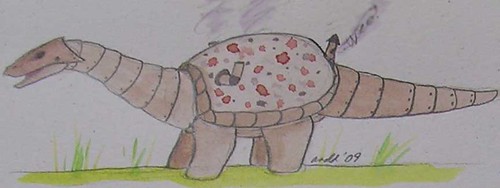
"Let's Read _The New Dinosaurs_" - Turtosaur

When I came upon the imaginatively-named Turtosaur (she is a descendant of armored sauropods like Saltasaurus), I felt the original illustration made her look more like a machine than an actual eating, breathing, pooping animal. Hence, Steampunk-ish Sauropod.


(Illustration by Jeane Colville.) Just reiterating how damn stupid the Wyrms are as a concept and a creature design. How does that not look awkward?

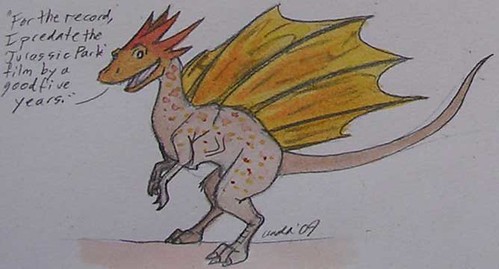
"Let's Read _The New Dinosaurs_" - Flurrit

If Wembly Fraggle and Tim Curry's hang-glider/cape-wearing character from "The Worst Witch" had a love-child, it would look like the Flurrit. She is a small theropod with wings made of flaps of skin. Once again, flaps of skin. Not feathers, flaps of skin. I've got no problem with this creature, she's just a sad victim of science marching on.

Or not, since we were well-aware of Archaeopteryx. Huh.


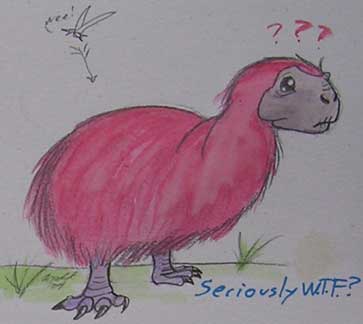
(Illustration by Steve Holden.) Seriously? Seriously. This is a Cribrum and... yeah. Australia is pretty much where Dixon starts to run out of ideas. To wit, the Cribrum's neighbor, the Gwanna:


(Illustration by Philip Hood.) I have absolutely nothing at all to add to this.

"Let's Read _The New Dinosaurs_" - Dingum

This is the Dingum. He is a normally unassuming, if strange-looking, theropod with a flashy crest on his head, a frill thing that pops up on an unlikely part of his body, and he defends himself with venom. This creature design is actually pretty cool, but I can't help but wonder if a different creature design team ever read this book...

As we leave Dixon's Australia, we meet one last pair of creatures. And they would easily be a shoe-in for the most WTF animals in the book (if there were no Wyrms):

"Let's Read _The New Dinosaurs_" - Kloon

This is a Kloon. She's pretty stupid-looking, but at least she's kind of ugly-cute.


(Illustration by Amanda Barlow.) The same cannot be said for her relative, the Wandle, who is a victim of yet another phenomenally ugly creature design. These animals are all flightless pterosaurs. Would you believe the Lank is actually less anatomically unlikely than they are? (In that he is a quadruped. That's the only reason though.)

"Let's Read _The New Dinosaurs_" - Clairvoyance?

So that we don't end on a bad note, let me point out Dougal Dixon's clairvoyance.

I must also direct your attention to Dixon's website. And, of course, to good old Specworld. And to this recent Scientific American Article about The New Dinosaurs. And to this even more recent Love in the Time of Chasmosaurs post, which showcases unusual alternate art and names for some of Dixon's animals.

Phew! What should I read next?