Showing posts with label book club. Show all posts

Wednesday, December 12, 2018

Go Get the New Edition of _After Man_ (SPOILER Review)


Or ask Santa for it, of course, since it's nearly Christmas already?!?  Good lord, that snuck up on me.  I apologize in advance for not doing anything crazy this holiday season; I'm still rather burned out after Inktober.  Head here for Christmas things.

But anyway, yes.  Get the new edition of After Man.  I pretty much had to get it anyway because, as you can see from the above photo, my old edition is pretty much loved to within an inch of it's life.  How much?


I'm holding it together with duct tape, staples, and prayers.  The new version is a sturdy hardcover with tough, glossy pages and it is very very nice.  Like, have it as your official coffee table book for the delight and confusion of your holiday guests nice.  It's THAT nice.

It is also *slightly* altered from the original 1981 edition.  I'm happy to report that this isn't an outright George Lucasing, the original text and illustrations are left basically alone.  There are a few edits to the introduction, but the biggest one helpfully cleans up the circa-1980's "protomammals" mess and the others are treated more as footnotes of the "Look at the cool things we've learned about this since then" kind.  Two creatures have been redesigned, however, and so here come the Spoilers.  First,

Art of the Week:
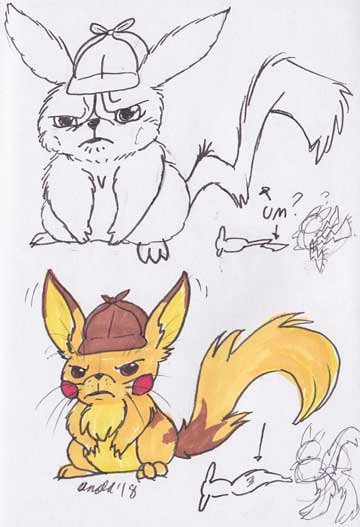
Speaking of fictional creature redesigns, here's my silly attempt to give Detective Pikachu less... *jarring*... anatomy:

11.13.18 - Detective Pika

But also...

-------

Okay, here are the new After Man illustration spoilers.  Note that both the original and revised illustrations are credited to Diz Wallace:


So the new Reedstilt is fine.  Weirder than the old design, which was already deeply strange to start with.  I don't like it as much; the old version is a lot more graceful.

Okay hang on to your butts, here comes the new Nightstalker:


Okay, it's redder.  And more... sinewy...  I'm not a fan, but I admire the stones it takes to redesign one of the very few creatures in After Man who can truly be called iconic

Thursday, February 2, 2017

Let's Read _Recreating an Age of Reptiles_

Mark Witton's Recreating an Age of Reptiles (or "Rec-A-Rep" to its friends) is first and foremost an art book.  If you want to learn about dinosaurs or art techniques, you'll have to look elsewhere.  That said, it is the kind of art book I savor: gorgeous art, introduced and explained by the artist.

It seems like a simple, obvious thing, but I really don't have many art books in my collection like this (the magnificent 1995 volume The Alien Life of Wayne Barlowe has a very similar format and oh, what would I give for an updated version).  Here, Witton gives us the grand circle tour of his paleoart, all along telling us what is speculation and what is based on solid evidence.  Pterosaurs are the stars, of course, but we get a lovely tour of the Triassic, unusual depictions of sauropods and ceratopsians, and even us lousy synapsids get our own little chapter.  This really is a beautiful book and an essential addition to your paleoart library.

-----

Art of the Day!

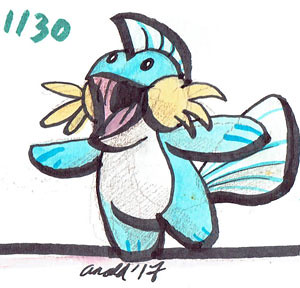
A Merry Moleskein Marshtomp.  (Don't ruin his mood and tell him Janphibianuary was kind of a flop.)

1.30.17 - Merry Moleskine Marshtomp

Tuesday, January 31, 2017

Let's Read _Dinosaurs: How They Lived and Evolved_

What a fantastic book Naish and Barrett's Dinosaurs: How They Lived and Evolved is!  It is a fine introduction to these fantastic animals that I love so much.  If I could afford it, I'd buy copies for every family I know.  Most of the information in the book will be new and mind-blowing for them.

Most of the information wasn't new to me, so the selling point for me was those incredible illustrations.  The book is packed with art.  I can't express how happy I am to see the work of artists I first encountered online in a big beautiful glossy book.

Best of all, we have here a book about dinosaurs where birds are included like it ain't no thing and therefore, this is a book about dinosaurs that does not end at the K/T extinction.  Goodness, this is the dinosaur book I've wished for since childhood.

Oof, that cover though... >_<

-----

Art of the Day!

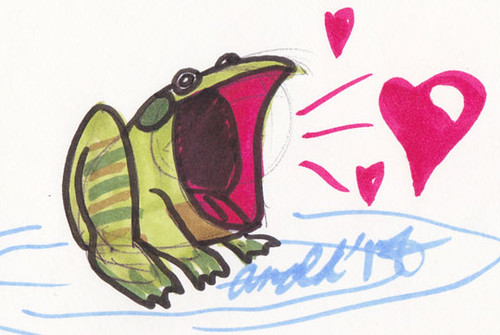
A tiny frog with a big, big voice to round out Janphibianuary.

1.21.17 - Janphibianuary

Wednesday, October 12, 2016

"In the Year 252525..." Let's Read _Man After Man_!

Note: Many thanks to Sivatherium for his extensive archive of speculative biology books on his lovely Neocene website, because the book has been long out of print and asking prices on Amazon are outrageous.  His is the version of Man After Man I read for this review and do please read along, as I'm not going to post any illustrations.

Ah, Dougal Dixon.  We've already explored his two signature books on speculative animals, and we've touched on some of his more obscure and incredibly strange science fiction biology works as well.

And I swore up and down that I'd never do a post about his Man After Man: An Anthropology of the Future.

This is all due to my first memory of sitting down and reading the book.  I was young, innocent.  I'd just devoured both After Man and The New Dinosaurs and I was ready for more.  I found a copy of Man After Man, bought it, brought it home, and sat down to read it.  And I was deeply, profoundly shaken to my core.  It had upset me that badly.  It upset me so badly, and remember this is preteen-logic at work here, I threw the accursed book into the recycling bin in the basement because I just could not stand having it in the house.  So there's my glowing review of Dougal Dixon's Man After Man from some time shortly after it was first published in 1990. 

Well, I am older now.  I've read quite a lot of pessimistic science fiction and it doesn't shock me the way it did back then, so I am breaking that promise today!  It's time!  Get a strong drink and a comfortable seat!  Do as I did and load up Sivatherium's archived edition of the book.  Tune your radio to the very easiest easy-listening station you can find.  (If the bioparanoia apocalypse has a soundtrack, it'd be even mellower versions of James Taylor and Amy Grant songs and the "St. Elmo's Fire" theme*.)  Notify your next of kin, because all your most horrifying bad dreams are about to be lovingly painted in vivid, fleshy, body horror-y,


-y detail by Philip Hood.  (Great day in the morning, this is a particularly epic Dixony Rolls Of Fat waking nightmare.  You know the kind of sick feeling you get when you stumble upon somebody's uncomfortably specific fetish art?  Yeah... 😨)

Humans are bastards!  Everything is horrifying!  God is dead and we genetically engineered Him away!  Transhumanist body modification is either going to kill us all or make us into hideous mutants living in our own special Hell!  Let's read Man After Man!

Bit of a side-note first.  Tetrapod Zoology has written about Dougal Dixon's works extensively and I'd be remiss if I didn't direct you to this wonderful interview with DixonMan After Man has always had an uncomfortable place among Dixon's books, and this interview gives some hints as to why that might be: he really didn't want to make this book at all.  Add to that the controversy of whether the creatures in the book were... *inspired*, let's say... by these Wayne Barlowe sketches and you've got yourself a book that could scream "I am a thing that should not be" as loud as the grotesque people who inhabit it's pages.

The book begins with an introduction by Brian Aldiss.  It already sets a notably more dour tone than Desmond Morris' introductions to both After Man and New Dinosaurs.  He talks about previous science fiction books that explored the possible futures of humanity, most notably The Time Machine, in which H. G. Wells depicted two different future species descended from humans.  He supposes that Wells and his influences "would like this book, and be horrified by it: for we have, after all, traveled a long way since their day, and supped on horrors beyond their resources.  We have lived through an age... when we have almost daily expected the world to be terminated."

Surely, we are in for fun times for all with this here book.

Dixon gives us a very quick review of how the process of evolution works and then emphasizes that we humans, with our penchant for unnatural selection and for modifying the environment to suit us rather than vice-versa, have effectively "broken" it.  So then, how are humans going to change into the freakish mutants promised on the front cover?  Simple: Genetic Engineering!  This, indeed, may be one of the earliest instances of "genetic engineering is a new technology that is poorly understood and incredibly powerful and can probably do anything and is almost certainly going to end the world as we know it" in popular science fiction.  That's something at least.

Next up is probably my favorite part of the book: eight million years of human history given in a series of short stories.  This short-story format continues throughout the book, and that means where this book could have easily been a sort of freak show, instead it has an uncomfortable intimacy.  In Dixon's previous books, the text was more like a dry field guide, but here we are invited into the lives of individuals.  It's a subtle but particularly nasty way to remind us that no matter how strange the creatures in the book are, all of them, every single one, is a human.

The parade of body horror begins 200 years in the future and ends -quite abruptly- five million years later.  Modern humans as we know ourselves survive for about another thousand years on Earth until the shifting of the magnetic poles wipes us out for good; we're simply too reliant on technology to survive that.   Long before that, those who could afford to and who were deemed worthy went off to outer space to escape the ravaged Earth, in ships built, in part, by humans who'd undergone massive genetic engineering and body modification.  Of these, Cralym the Vacuumorph is the most extreme and perhaps the most upsetting.  She is a creature born to die, after serving her purpose of building the ships that will send her normal human parents to a new home. There is a question as to why people of the future would create such an extremely mutated human instead of, say, a machine, but this book has biotechnology as it's science fiction trope of choice and it's sticking with it.  Anyway, Cralym's story sets the tone for the wild ride we're about to head on.

And all told, this is some darn good "Far out, man"-style science fiction.  We meet the Mechanical Hiteks, cyborgs who are basically a brain in a box, and who are horribly vulnerable outside of their robotic vehicles.  The Earth is starting to recover by their time, and so the Hiteks create new species of humans to take the place of the large animals that roamed the wilderness.  The Hiteks themselves are succeeded by Tics, who live in what are essentially meat-mechsuits.  Yup, fleshy bio-engineered meat-mechsuits with those good old Dixonian rolls of fat as far as the eye can see.  They and the few remaining normal humans have the decency to die out, as previously mentioned, leaving the engineered new human species to their own agendas.

And oh we have such sights to show you.  The Memory People are blessed and cursed with a "racial memory" that allows them to find rich sources of food but also essentially leaves them with "Koyaanisqatsi" running through their minds at all times; they voluntarily let themselves go extinct, lest they be tempted to become industrial humans again.  Dixon's love of eusocial animals manifests in the Hivers, descended from humans modified to live on grasslands, they live in massive castles with a perpetually pregnant Queen (nope), and have a symbiotic relationship with a Seeker (nope), who starts off as a fairly normal humanoid with the psychic ability to find resources in harsh environments (what) and eventually evolves into a big-headed, limbless baby-thing the Hivers must carry around (nope).  And there are the Tundra-people and Forest-people made kind-of-famous by this:


The Forest people are the most similar to the ancestors of all humans, which means that they are both the most adaptable and the most prone to being right little bastards.  Once the technologically advanced humans are gone, leaving nature to take its course, they and the Tundra People diversify into the most bizarre mutants.  One group of the Tundra and Forest people eventually become telepathic symbionts, all because a Forest person, driven mad by cold, tried to hunt a Tundra person like this and ended up sat upon -but not crushed- by their would-be prey.  Sure.  Another group of Tundra and Forest people became host and parasite, the Tundra person becoming a walking mountain of flesh to carry and feed nasty little vampire guys.  At the four-million year mark things really get outright bonkers, with the Tundra people becoming "Sloth Men" who are preyed upon by Spiketooth descendants of the Forest people, who also give rise to specialized fish eaters (a dead ringer for the piscaverous ape in After Man) and, because this is a Dougal Dixon book, ant-eaters.  This is all after Forest people have been shown to make and use tools, so I don't even know.

It's in the Year 5,000,000 and a half where everything goes to hell.  This is probably the most infamous chapter of the book, where aliens invade Earth, enslave the mutants, mutate them even more horrifically into thoughtless biological weapons and living meat stores, and strip the land of all it's resources before blasting off again, leaving everything dead.

Did you guess who those aliens were?  They were the distant descendants of the humans who left Earth millions of years ago!  Woah!  It really makes you think, doesn't it?

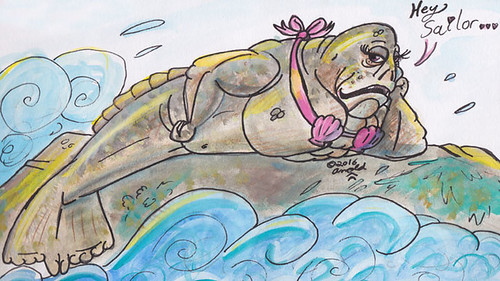
Fortunately, all is not lost, as there are people who survive the Apocalypse.  Yes, the Aquatics!  For my money, these mans after mans are the most... haunting. It's the eyes.  And also the "mermaid tail" and the fact that we never really get an explanation of how it works, anatomically speaking.  And the most of them, really.  Anyway, these... merfolk... technically... they survive by camping out by the deep sea vents.  It's implied that once the world recovers enough, these people will repopulate the planet, and it will be full of life again.  So that's nice.  I guess.

Thank you all so much for joining me on this journey through the world of Man After Man.  I am going to have a lot of wine and a good long stare into space.

* - Sweet Christmas, somebody make a mostly straight remake of "St. Elmo's Fire" -- except all the characters are genetically modified affronts to nature.  Dammit, I want to watch this hypothetical movie right now!  I am so angry at myself for making myself want it so much!

-----

Art of the Day!


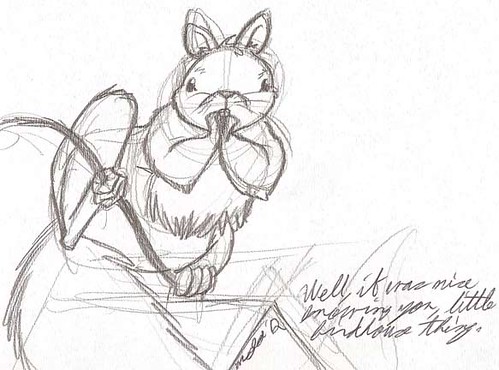
I am full of regrets...
_Man After Man_ Mermaid

Wednesday, March 27, 2013

Reasons why you need Katrina Van Grouw's _The Unfeathered Bird_

It Fills a Massive, Obvious Gap in Your Animal Anatomy Library - Remember way, way back in 2009 when I reviewed Eliot Goldfinger's massive tome Animal Anatomy for Artists?  And how I was so stunned and disappointed that, for all the gorgeous and rigorously accurate studies of a wide variety of mammals, he only illustrated the internal structure of one bird?  And it was a domestic chicken?  If you were just as put off by that, The Unfeathered Bird is for you.

It Makes That One Chicken Look Embarrassing - Really embarrassing.  Van Grouw has rendered staggeringly beautiful studies of at least one species of every major clade of extant theropod you can imagine and a not-insignificant number of clades you can't, plus a couple of extinct species.  She even goes so far as to illustrate the often insane extremes of domestic ducks, chickens, and pigeons.

It's a Comparative Anatomy Book in the Truest Sense - Van Grouw has grouped different unrelated clades of birds via a long-antiquated system that rather arbitrarily bunched similar-looking birds (ie, all long-legged, long-necked birds) together regardless of actual relationships.  The arrangement of the book, I will admit, confused me at first, but it facilitates comparison between species adapted to similar lifestyles.  She does clarify, as much as she can, who is actually related to who in the body text. 

Man, You Think You Know Birds... - There are some crazy reveals in this book.  Whooping Cranes have a windpipe that loops around inside the keel of their breastbone, creating essentially a live French horn.  Screamers posses vicious, claw-like spikes on their wrists.  Toucan nostrils face backwards.  Swifts have xygodactyl feet, quite contrary to every other illustration.  And, of course, necks lie.

It's Just Gorgeous - Seriously.  I can't imagine the work involved in preparing a book of this scope.  The fact that it's a fabulous work of art is icing on the cake.


-----

Sketch of the Day! Had some visitors earlier this month.

2.28.13 Hawks

Thursday, January 12, 2012

In Which Trish Reads _Vegemorphs_ So Adam And Ifi Don't Have To

So, here is a thing that exists:

This thing that exists is the creatively named parody, Vegemorphs, written by Leif E. Green (son of a...) and published in 1998 by Troll Communications. And it is assuredly and objectively the SECOND-strangest book I have read that attempted to cash-in on the Animorphs series.

Right off the bat we get a pretty dead-on parody of the famous
Animorphs opening, "I can't tell you my first name - or my last name either. And I can't tell you where I live. But I might be lying in your refrigerator's vegetable bin or in the produce section of your local supermarket right now." This is Kale Kyle the leader guy. Rounding out the rest of the cast are Carrot Cary the wacky smart guy, Olive Olivia the... however you'd categorize Cassie I guess, Tomato Tommy and Radish Randi the other two (literally, they're here so that there can be five humans in the cast), and the evil Jerkks. It's that kind of parody.

By the way, it's 1998 and Kale and company "like to wear funky clothes, listen to alternative music, and do crazy things." They also hang out with old ladies in a Bingo parlor. Yup.

It's on the way home from playing Bingo that the gang runs into a giant flying mushroom that is covering a farmer's field with fungal spores. Shortly afterwards, they meet Prince Brassica, the talking broccoli and the wise and brave ruler of the Vegetable Kingdom. The Prince informs the kids that certain otherwise ordinary plants are as intelligent as humans but are unable to speak to normal humans. They are extremely rare because they live most of their lives underground and the few who venture to the surface risk getting eaten. They are also at war with the Jerkks, evil fungi who want to infect everything alive on every planet they land upon, and they are losing badly.

But Prince Brassica has a new plan. He will use his magical salad dressing to give his new human friends the ability to transform into giant talking vegetable-people who will better be able to fight the space-fungi.

I promise you, I am stone-cold sober right now. (At the time of writing, I mean.)
The kids agree to all this because I guess being a talking vegetable is at least more exciting than playing Bingo. It's worth quoting Kyle's description of Newman's Own Escafil: "I felt tart and tangy, crisp and cool, hot and spicy, crunchy and mellow - all at once... It was like I had been all mixed up - and now everything was mixed right. I had been tossed."

Kyle's salad... has been tossed...

AAAAaaaaanyway. So for those of you wondering if turning into a talking vegetable is the worst kind of Blessed With Suck, it... well, it isn't the WORST kind, but it's close. You can smell a vegetable and then transform into a vegetable-person, but you can also make your clothing invisible, turn into a normal vegetable, shoot a magic beam of vitamins and minerals at people, and transform other people into talking vegetables because...??? If you are wondering, we're not told why you can turn into a tomato or an eggplant if the magic supposedly only works on vegetables. Oh, and of course there is a time limit. Stay a vegetable past the "recommended cooking time" and you're stuck like that. Wee. (For the record, a character does ask whether that means "steamed, stir-fried, boiled, or microwaved" before getting his question shot down.)

Enter the villain: his name is Fun Gus. Of course it is. And he is a Rubrum fungus that can turn into a giant vegetable. And he dresses like Urkle. And he drinks celery juice made from his enemies. And he holds evil secret meetings called the Snorings, where people go to eat mushroom soup and be infected by fungi in their sleep. And he stinks. In fact, he and his followers' favorite battle tactic is to swarm all over their opponents and make them sick.

The kids escape the battle and run home. And in the morning Kyle wakes up to find that Cary has somehow entered his room and has turned into a carrot-person. Cary then turns into a normal carrot and talks about how awesome being a carrot is and how he actually wouldn't mind being a carrot forever and could Kyle hop downstairs and get some salad dressing and pour it all over Cary's carrot body and oh God what? WHAT?
WHAT?!?

Thankfully Kyle's mean older brother arrives before things get wicked awkward and since he is wearing tacky clothes and is suddenly obsessed with animation (something I have to point out because I am me) he has obviously been infected by the (
sigh) Jerkks. Specifically, the dreaded Streptococcus or Strep Throat bacteria. One of (*sigh*) Fun Gus' other favorite tactics is to turn fungi and bacteria which are normally harmless, like Trichophyton, evil and super-virulent. I was previously unaware that the fungus that causes Athlete's Foot is more often than not mostly harmless. This is a hell of a context in which to learn that.

So the gang gets together and practices turning into vegetables and turning other people into vegetables and endive right into stalking bad guys to get right to the root of why they can't leaf the Vegetable Kingdom alone peas kohlrabi nasturtium and - sweet mother of Gregor Mendel there are so many vegetable puns. Like, an entire Xanth novel's worth of awful puns in a little over a hundred pages.

Anyway the gang causes some chaos in the local salad bar where they meet with Prince Brassica again and he explains their new plan. They will invade the next Snoring as vegetables with anti-fungal cream smeared all over themselves, hijack a delivery truck full of anti-fungal cream, and then zap everyone with their vitamin and mineral beams.


I just wrote that, right? I just actually wrote that.

Well, the battle goes surprisingly smoothly, and is even helped along via Deus ex Machina, a big thunderstorm that washes away all the evil fungus. Fun Gus goes underground, presumably shaking his fist like an 80's cartoon villain, and the Vegetable Kingdom warriors are at the ready whenever he returns in the sequel that will never happen. The downside is that Cary is now a carrot permanently, but he's now living among the Vegetable Kingdom warriors and is happier than he has ever been.

Repeat: CARY IS HAPPIER ABOUT BEING A
F***ING CARROT THAN TOBIAS EVER WAS BEING A HAWK WHICH, just as a reminder, IS NOT THE GODDAMN ROOT OF A GODDAMN PLANT AND CAN F***ING FLY!!! Wow.

So there you have it, I guess. For the curious, a version of the book with a different, spooky cover and credits is available at Amazon. It's worth visiting the page for the comments alone.

Now, since I think I am spent, who wants to tackle these things or these things?

-----

Sketch of the Day

Here is a squirrel:

1.2.12 - Sketchbook Page

Thursday, May 27, 2010

Iguanodons like KISS. A lot. Let's read _Dinosaurs Disovered!_

(NOTE: I apologize for the crappy photos throughout this post. I would have used my scanner but this book is very old.)

As mentioned in an earlier post, I found something for four dollars at Amazon.com that I had to buy immediately:


John Gilbert's
Dinosaurs Discovered, with illustrations by Guy Michel, was the only nonfiction dinosaur book I owned as a child growing up. It was published in America (translated from the French) in 1979. I have no idea why or how I acquired this book, and I never even read any of the text (hell, this was the first time I ever read it at all). But the illustrations in this book are lodged deeply in my subconscious... even though science has marched on and left this artwork in the dust.
 
Hey, I may have gotten some strange comments (but also a Crowning Moment of Awesome) on this drawing, but wait until you see some of the old depictions of dinosaurs in this book. Heck, just look at the cover scene above. No wonder Greg Paul rocked my world when I found his art.
So, let's take a look at our cast of characters:


Hoo boy. Dig that Velociraptor in the upper-left. And get used to seeing Iguanodon with a giant scary tongue, you'll be seeing it a lot:


Iguanodon figures prominently in this book because the focus is not about the lives of dinosaurs as it is about the history of paleontology. That may go a ways to explaining why some of the information about the dinosaurs themselves tends to be... strange. Apparently, there was a theory -now faded into obscurity- that Iguanodons had long prehensile tongues like giraffes. There's a handwave given that one particular paleontologist looked at the lower jaw bone and decided that they indicated a long tongue. The text says that this has since been debunked... yet every Iguanodon in the book is doing their Gene Simmons impression. Huh. You tend to see text-to-illustration discrepancies a lot in older dinosaur books, and it's most often because so many of them relied on illustrations recycled from other texts.
Anyway, here's a montage of animals dying in horrifying ways:


The famous Bernissart Iguanodons fall to their doom and into history.


No offense to that Hadrosaur, but for my money this is the unintentionally funniest painting in the book. It's the wonky anatomy (what are his arms
doing?) and the "Aw, damn" look in his eye. Also, the hilarity of an animal who is depicted as an aquatic creature (we'll get to that) wandering onto land... to get eaten by an aquatic animal.
It's also pretty graphic and horrifying, so who knows why my parents let me read this as a six-year-old.


Actually, this one's pretty hilarious in it's own right. This is as good a time to point out that the Real is Brown trope affected paleoart like nothing else ever.
It's hard to see here, but the Tyrannosaur's face is just a mass of warts for some damn reason. It may have been an attempt to illustrate what we now know as Tyrannosaurs' facial crests. It's one of the strangest interpretations of a dinosaurs' appearance in the book.

But here's the weirdest:


When was the last time you ever saw a stegosaurus drawn like this? Weirdly, there are more conventional looking stegosaurs in the book too. It's like they were hedging their bets that at least one of the spikey-thingy configurations would be accurate. It confused the heck out of me as a little kid, though, especially since there was no explanation for the two different interpretations.
So about those aquatic hadrosaurs:


This was the default illustration for any and all hadrosaurs for the better part of my childhood. And as far as anyone knows the reason -the one and only reason- why hadrosaurs were depicted as aquatic creatures is all in the beak. It looks like a duckbill, so they *must* have swam around in the water all day like ducks... right?
Speaking of swimming...


I don't even know what I could add to this. This might just be the single strangest image in the whole book.

----

Sketch of the day!
I glossed over how the book treats theropods, so here's my take on a Ceratosaurus who appears in the book. D'awwwww...

5.17.10 - Gonkasaurus

EDIT: By a happy coincidence, the wonderful Tetrapod Zoology blog has referenced Dinosaurs Discovered as well. Darren points out a particularly weird non-dinosaur reconstruction in the book I never even noticed (as you've seen, there's a ton of trippy stuff in the book).

Wednesday, February 10, 2010

Quick book review: Eric Goldberg's _Character Animation Crash Course_

Well, this certainly wasn't what I was expecting but it was still a pretty interesting read.
I'm not sure if the "Crash Course" in the title is accurate though. Goldberg assumes you have *quite* a lot of prior knowledge. You know who Chuck Jones is, right? Well good because if you didn't I'd have to banish you from my sight. But do you know who Ken Harris and Gerry Chiniquy are? Because the author kinda assumes you do. You also better know how an exposure sheet works, otherwise this book is going to be very technical-looking for you.
And the book overall is technical almost to a fault. There's very little art in the book itself, although the art that is included is very good. I still have a hard time recommending this over, say, Preston Blair's classic Animation books.
"But Trish," you're thinking, "doesn't Goldberg's book come with a CD-ROM? What did you think of that?"
I have mixed feelings about books that include CD-ROMs. One of them is usually, "get with the times, dudes and dudettes; last time CD-ROMs were cool was that one facepalm-worthy line in 'Jurassic Park'." What I mean is that including a CD-ROM in with your book often feels too gimmicky; why isn't it in the book itself if it's worthy information?
But Goldberg's CD-ROM broke down my barrier here, because he uses it to demonstrate something important about the art in his book: it has to be seen in motion. Many pieces of animation from the book are made into Flash files which you can either watch at normal speed or frame by frame. It almost makes me wish he had produced an instructional DVD instead of a book. If anything, it would have given him the opportunity to give the reader/viewer more information, more film clips, and the whole thing would have been a lot less expensive (I feel a little buyer's remorse-by-proxy as this was a Christmas present.)
My verdict: borrow this from the library as it is an interesting read for sure.
----
Sketchatheday! I have made more ACEOs for you!
Pegasaur ACEOs!

----

Bonus/Addendum: My already-"Jossed" crazy theory! Let me show you it!

2.10.10 - My crazy theory, let me show you it!

Friday, October 2, 2009

Megafauna's Back Baby! Let's Continue Reading _After Man_!

We're taking a tour of Dougal Dixon's classic sci-fi biology book, After Man, A Zoology of the Future, which envisions a world fifty million years after all modern large animals go extinct. Read the first half here.

Now, as I said before, this book was published in 1981, and it's animals were probably invented long before that. The science is a little dubious when seen through modern eyes, but for the most part, the artwork is still very good and most of the fictional animals are just plain cool-looking.


I said MOST of them!

Illustrations by Diz Wallace. Now, this wouldn't be a book review by me if I didn't point out a few weird and or... unpretty creature designs. The shrew-descended Tree-Drummer and Reedstilt (like the infamous Wyrm) don't really make any damn sense unless there are absolutely no animals more qualified to fill these niches. There
are tree-boring birds and long-necked fish-eating birds in the world of After Man so...


Illustration by Diz Wallace. As I said in the previous post, we can't play the Dixon Drinking Game unless we change the rules a little, as there are very few animals who sport rolls of fat. Here are the Turmis, a kind of pig-elephant, and they will be your unlikely ant-eating species for this evening.


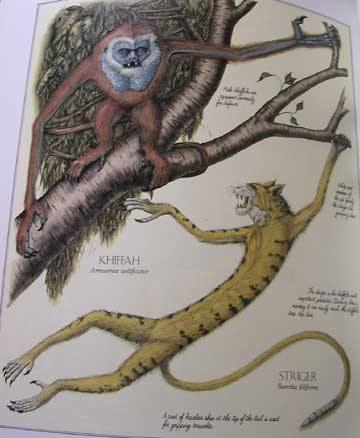
The happy fellow in the upper-right of this illustration (once again by Diz Wallace) is the Khiffa, and he and his colony will be your unlikely colony-dwelling species for the evening.
 

And dig the Striger; a creepily anthropomorphic climbing cat.


The Tusked Mole is the first of a few animals whose lifestyle might not have been thought out all that well. I would have thought tusks that stick straight out of your face would get in your way while digging.


The Night Glider is similar in that respect. It's essentially a predatory flying squirrel, dropping silently on it's prey from the 'bove (A). Unfortunately, gliding animals can't really fly without a leaping start and cooperative winds, so I'm not sure what the Glider's supposed to do with it's prey after succeeding in securing it (B).


And now, the saddest imaginary animal ever.


Illustration by Diz Wallace again. Man, how did
that conversation go? "You want me to draw the saddest imaginary animal ever? OK!" 

The Slobber is a creature that does exactly what you see her (yes, her; that thing clinging to her stomach that looks more like it's sticking out of it is her baby) doing all day long: catching insects with her drool. This is not a pretty mental image.

And then, there is the infamous Parashrew:


I have nothing at all to add to this, so bring on the Giant Penguin-Whales!!!


Diz Wallace yet again. "WHAT?!?"


Hell, I love the Pelagornids and the Parashrew. The sheer ridiculousness of these animals is impressive. For one thing, I've seen the B.S. penguins need to deal with every spring. You gotta figure that if penguins were ever going to develop the ability to bear live young instead of laying eggs, they'd have done so by now. I also like the fact that a whale-penguin is right out of "Avatar: the Last Airbender".


I can be as sarcastic as I like, but
After Man is a classic of it's genre. It has had a lasting influence on myself and anyone else who has ever wondered "what if?"

Plus it kicks the stuffing out of "The Future is WAAAY Too Trippy Wild".

----

Totally unrelated, but you may have started to see the TV spot for "The Princess and the Frog" last week. If not, it looks like this, but shorter (embedding is disabled). Now... I'm on good authority that the full film is better than this looks, and I desperately want the film to be better than this looks (it's absurdly unfair that so much should be riding on this one film). But is anyone else getting a nasty "Rock-A-Doodle" vibe from this teaser?

Wednesday, September 30, 2009

The Humans Are Dead, But There Are Jackalopes Now! Let's Read _After Man_!


I'll warn you right away, my nostalgia filter may be strong with this one. Indeed, you may run into many science fiction fans / armchair biologists / creature designers / ect. around my age whose young minds were permanently blown by Dougal Dixon's After Man. The New Dinosaurs, in hindsight,
might actually be better, but I find it very hard to have many bad things to say about After Man and it's various creatures. As the delightfully named Caustic Cover Critic says, the book is "deeply odd and quite fascinating."

After Man
was first published in 1981 (and the creatures were likely invented well before that, so take the science with a grain of salt), but I first learned about it through one of the Museum of Science's stranger traveling exhibitions. It was called "Future Zoo" and it was essentially a walk-through version of the book, with paintings on display, sculptures and animations of the animals, and even a robotic Desert Leaper (a la those wonderful traveling robotic dinosaur exhibits). Sadly, there does not appear to be any information about it online, so I have to go by my foggy memories. The exhibit was really the first work of hard science fiction that spoke to me as a child, and once I learned there was a book I HAD to have it.

Flash-forward nearly
ten, maybe even fifteen years to the frabjous day when I spot this, totally randomly, in a random gift shop:


Now of course I bought this on the spot. All told, I've only seen two copies of this book in person. Sadly, they were both incredibly cheaply bound softcovers. Before I start giving you the tour through the book and post more pictures, I need to show you what condition my copy is in now:


Illustration by Gary Marsh. Talk about loved to death. Long out of print, Dixon's books are notoriously hard to find nowadays and known copies tend to be expensive. Here's the Amazon link if you'd like to try your luck.
 

Anyway, the introduction of the book serves mainly as a refresher course of basic evolutionary biology. It also reminds us that many of the animals around today had ancestors that would be completely unrecognizable to us.
 

This will prove to be foreshadowing, as the world in After Man is one that had been long ago inherited by the meek. As the title suggests, the humans are dead. So are all the other animals human-sized and larger. The world is very different now, after all the large animals went extinct fifty-millions years ago in the early 1980's.
 

This kind of thing comes with the territory of setting a book in the future. Just go with it.
But with that said, you have to remind yourself what most science fiction dealing with future evolution was like prior to
After Man. Typical scenarios include things like, "humans will keep getting smarter and smarter but they will also have terrible powers and be evil!" "There will be all kinds of giant monsters with big teeth and claws and blah!" And the good old chestnut, "radiation will cause normally innocuous animals to mutate and try to kill everyone!" Come to think of it, that last one is still around in full force; just replace "radiation" with "genetic engineering" (or, frankly, "writers who failed biology").
 

That's why After Man was so refreshing. It was also the first time many of us saw imagined animals treated with utmost respect and painted as if they were real. Here's one of the first illustrations in the book, introducing two major groups of future animals, the Rabbuck and Predator Rats, and it's still awesome:


Illustration by Diz Wallace, affectionately parodied here. This is how you illustrate creatures that don't exist. (Though it is a huge missed opportunity that the Rabbucks are not actually called jackalopes.) I wouldn't be surprised to see this exact scene in a real Victorian-era natural history book.


Illustration by Philip Hood. We've met two of the three major groups of animals in the previous illustration (the Rabbucks are large deer-like animals descended from rabbits and the Predator Rats are... exactly what it sounds like.) These Hornheads are in the third group, the Gigantelopes. Only the very small hoofed mammals like caprids survived into the future. I just like these guys because I have a soft spot for moose, sheep, and hadrosaurs.


Illustration by Philip Hood. Here's the lovely Desert Leaper, essentially a gigantic jerboa who has filled the niche left wide open by the camels. For those of you playing the Dougal Dixon drinking game, note that this guy is one of maybe three animals in the book that displays (ahem)...


Now let's meet the fellow alluded to in the beginning, Nightmare Fuel on Legs the Night Stalker, a predatory flightless bat.


Illustration by Diz Wallace. This illustration found it's way into several other sci-fi books and (subconsciously at least) into a number of character designs.
 

Gosh, this is already getting to be longer than I expected. Let's stop here and meet more of the animals in Part Two.
 

And here's the old Tetrapod Zoology post that got me thinking about Dixon's books again.
 

And, hey, it's Banned Books Week! I'm sure After Man has been challenged at one point or other. Or it would be if it were less obscure - which is one of the things about the Challenged Book List that gets me. (It seems a book isn't controversial until it gets popular or attention in the mainstream media. Note that it took a while for His Dark Materials to crack the top ten.)
 

And for the love of Benji, people. They're PENGUINS. (But I'm suddenly curious to know how, exactly, these penguins are also "anti-ethnic". WTF?!)

Monday, September 28, 2009

_The Time-Traveler's Wife_ , "Howl's Moving Castle", and other old reviews rescued from MySpace

(Originally posted on 3/22/06.)
When I started my old MySpace blog, I was on the hunt for a decent book. I had quite a few disappointments, even giving up on books that had been highly recommended to me. So I halfheartedly pick out a book I'd seen at the Library for some time now that looked kind of interesting, Audrey Niffenegger's The Time-Traveler's Wife. Go figure, it ended up being the first book in a long time that, about three chapters in, I had to do the Neverending Story thing with. (Neverending Story thing = Locking oneself in an attic and finishing a thoroughly amazing and engrossing book in one go. You know what that's like don't you?
Don't you?
I am a nerd.)
This is a book that made me laugh, it made me sob, it made me blush, and it made me shudder and - this is the kicker right here - the f___er made me think. And best of all, it made me think in the same way that my favorite truly thought-provoking fantastic fiction made me think. It takes a worn out fantasy concept and treats it with all-out seriousness, daring to ask what living with this fantastic element would really be like. (What I mean by this is, for example, that we learn the sometimes kinky, more often heartbreaking, and darn near always hellishly confusing and upsetting ramifications of quantum sex.) Imagine a good mash-up of "Eternal Sunshine of the Spotless Mind", "The Sixth Sense", and "Memento". It's an emotional and mental workout, but it is well worth it.
And if I haven't sold you yet, there is the fact that your secret loathing of Bob Seger's "Old Time Rock-n-Roll" is finally vindicated in this book. Yes.

I must now heap praise upon Hayao Miyazaki's "Howl's Moving Castle", which is on DVD this week. Now, If you're ever going to trust me on any movie recommendations, trust me on this. The Studio Ghibli films are Anime for people who don't think they like Anime. Everything Disney nailed in their heyday can be found here. I highly recommend you check them out.
"Howl" is Miyazaki's latest triumph. Dude must be sick of hearing that. Doesn't he get bored of making superior movies? The characters are absolutely delightful and I love how there are more interesting things going on in any given background painting than some animators put into an entire feature. (It's almost poignant seeing the "Chicken Little" teaser trailer on this DVD.) That said, it might not be the best place to start for newbies; I say start with "Kiki's Delivery Service". It's my favorite (if I have to pick) and the most easily accessible of his films. From there, watch "My Neighbor Totoro" (one of the best children's films ever and just released on DVD), then try "Nausicaa of the Valley of the Wind" and "Princess Mononoke" (two of the great action-fantasy Animes of all time), and then "Laputa: The Castle in the Sky", "Howl's Moving Castle", and "Spirited Away" (surreal fairy-tale fantasies). And keep an eye out for "Little Nemo" - an underrated Studio Ghibli production but one of my favs.
Incidentally, I have to mention something about "Howl" that I find very, very strange: some critics have said that the plot is too convoluted. Honestly, I didn't find it any more hard to follow than other Anime. Whatever, dudes. Next you'll be complaining that chocolate tastes too good or something.

I got two strange animated films from the fifties at an evil supermarket for a dollar. They were "Panda and the Magic Serpent" and "Adventures of Mr. WonderBird". And they were actually pretty good.

And finally, I watched "Harry Potter and the Goblet of Fire" on DVD. Dad and I both agreed that it was pretty good. We also both agreed that, although we know the work that the person in charge of condensing the "Brick" Harry Potters into films has cut out for him, it was very strange some of the things left out. The SPEW subplot is an obvious example. But where was the payoff to the Rita Skeeter subplot? And for cryin' out loud, how come we didn't get to watch the Quidditch World Cup or how the other Triwizard Champions battled their dragons? Honestly, as I was reading the book all those years ago, I was secretly thinking to myself, "You just know J.K. put this in because it'll look kickass in the movie." The more I think of it, the more disappointed I am...
I might have fully transformed into a Harry Potter nerd right there. Hang on...
Iorek Lives!!!
That's better.
----

I've rescued a few old posts from MySpace and they'll be popping up over the next month.
And, there's a new review at The New Realm. Starting next month, there will be new reviews (or shamelessly recycled features with some new material) every week!
AND, I've uploaded a bunch of new art (and older art that I'd unintentionally hidden from myself earlier this crazy summer) at Flickr. Here is a sample, and you may consider it blatant foreshadowing of a future article:

4. Revenge of the Nibblers

In sillier news, did you get Oak's Letter yet?

Thursday, September 24, 2009

You must all read Lev Grossman's _The Magicians_. Because of Awesome.

Yes, I've read a book that was (all too briefly) on the New York Times bestseller list. Try not to freak out.
And it is very good. Scratch that, it's awesome. Grossman has basically freely admitted that he initially wrote the novel to contain all the awesome stuff he loves in fantastic fiction.
This is that rare work of fiction that, very like "Who Framed Roger Rabbit", rewards you for being a fan of the genre. And it also serves as a by turns bleakly funny satire and heartaching deconstruction of the fantasy genre.
The novel takes on two very big targets directly. The whole subgenre of wizard school novels a la
Harry Potter and Earthsea is the subject of the first large section of the book. What happens when a magic student graduates anyway? And I'm not talking about a Ged or a Harry Potter or an Ender, just a no-name nerd in Ravenclaw house. What are they supposed to do after school?
A lengthy deconstruction of
The Chronicles of Narnia forms the bulk of the second half of the novel, and as someone who was always subtly irked by the central conceit of a magical land populated by powerful mythical beings who for some reason require the aid of some random Earth schoolkids to save them, this made me very happy. The characters even call the Aslan-equivalent character out on waiting around for them instead of helping his people.
Really, though, read the book. It might be the greatest genre-busting novel I have read since The Time-Traveler's Wife (and, gosh, I need to rescue that review from the depths of my abandoned MySpace blog.) Do not resist the Awesome. I'd love to hear reactions from non-fantasy fans and readers new to the genre.
Oh, and here's the sketch of "The Final Charge" alluded to in the last post:
9.2.09 - "The Final Charge"
As always, click for massive. I'm not going to lie. This might be the baddest-a**ed thing I drew all summer.

Friday, July 17, 2009

Let's Read Every Harry Potter Novel in a Row!

A repost from my old MySpace blog.
I was unable to attend the release party at Harvard Square for Deathly Hallows (I was there entirely by accident for the
Halfblood Prince release and to this day it remains one of the times I most regret not having a camera on me.) So instead, I decided to build myself up to reading the last Harry Potter novel by reading every piece of literature related to the saga I happened to have with me.
Originally posted 6/29/07.


I'm glad I did this. Not only was I able to appreciate for the first time how much deeper this series is than most people appreciate, I was also more able to appreciate the scope of the final novel (which gets it's own spoilerrific post after this one). And since I'm crazy and have a bit of a self-indulgent streak, here's the play-by-play:

Day One (July 14): Harry Potter and the Philosopher's Stone
Thoughts from the very first chapters:
* - Harry ain't gonna die. If he does, I will -er- do something silly.
* - I'd forgotten how Roald Dahl-esque the series really is.
* - Raise a pack of Lemonheads for Albus. <:( * - Already with the spiders! And she's introduced Sirius and Miss Figg too! J.K. loves her foreshadowing. * - Note the obsession with food. And Draco is already a racist little sh*t. And did Scabbers just save Ron? * - Snape is definitely on the Chaotic Good side. No doubt. (Maybe a little.) * - I'm a bit worried that we really may be headed for an irony-soaked, very confusing ending a la "Fullmetal Alchemist"... This is probably the longest I've ever taken to read a book I have already read before. It's a hell of a lot better than I remember.

Day Two (July 15):
Harry Potter and the Chamber of Secrets
I've always been a bit lackluster about this particular book. But it is supposed to be one of the most important from a plot-building stance. It is better than I thought, but it does play out like "Harry and the Attack of the Foreshadowing". If nothing else, it's cool to notice that she introduces Mundungus here.
Incidentally, I do not buy the argument at all that the saga has gone "dark" (whatever that means) only in the last three or four books. There's some heavy stuff going down already here in Book Two. (Moaning Myrtle is just an overall creepy character. There's also giant man-eating spiders and Dobby's self-flagellation.) Whatever, it's time for Book Three which is the point where I first admitted we were reading something special.

Day Three (July 16): Harry Potter and the Prisoner of Azkaban
This is the one that got me hooked. Not much else to say there.

Day Four and Five (July 17 and 18): Harry Potter and the Goblet of Fire
The first of The Bricks. I got way too much sun reading outside on Day Four so fortunately it rained on Day Five. You'll notice I was cutting it very close to Release Day, so I had to remind myself that I was about as isolated as I could get, I'm not really an obsessed Person of Fandom who needs to know how the saga ends right away, and basically I can take my time if I want. Still, it bothers me a lot when it takes a great deal longer than expected for me to read a book I have already read before.
Fortunately, I got to the ending of Book Four by the end of the day. Fans call this the "Empire Strikes Back" part of the Potter saga. I call chapters 32-35 the "Holy Sh*t" scene. I'm sure it inspired more than a few nightmares. And thank goodness for that. Really. It's so much easier to tone a villain down these days. It's actually a lot more satisfying to have a villain who really is evil, therefore the hero's conflict is far more tense.
In other words, I take back all the detracting things I have said about the saga over the years. Aww.
(Well, almost all of them.)
I topped off the night with the two little interlude-like "Textbooks" (
Magical Beasts and Quidditch Through the Ages). World-building is fun.

Day Six and Seven (July 19 and 20): Hary Potter and the Order of the Pheonix
I finally finished the 870 glorious pages of Book Five on Release Day! Reading this book at a leisurely pace is a fine reminder of just how damn long it is. I remember blitzing through it the first day I got it. Not a good idea. There is a metric buttload of information to digest here. All I can say is that if bacon and Crumple-Horned Snorkacks do not figure into the finale somehow, I will be sad.

Day Eight and Nine (July 21 and 22): Harry Potter and the Halfblood Prince
Joy and rapture, I received my package from Amazon at 11:00 AM on Day Eight. While waiting, I read Book Six. Basically, this book, while good, is "Fast Times at Hogwarts School", juxtaposed with a massive amount of exposition and topped off with a tragic ending. At this point, I felt like I was vacationing with the characters.

So.
So there I was ready to read the final book in the Harry Potter saga. At once, I was excited to see how she'd wrap everything up and rather bummed to see the story end.
Thing is, as a fantastic fiction fan, I've been in this situation before. Lord knows how the eleven-year-old fans are feeling.
My reactions to Harry Potter and the Deathly Hallows will be in the next post, and there will be spoilers. Until then,

***Drinking Game!!!***
Take a sip for...
* - Bacon!
* - Something unpleasant happens during a Quidditch game;
* - Harry gets somebody "Monologuing" (one sip for villains, two sips for good guys);
* - Every time somebody gets sent to the Infirmary;
* - Harry breaks out his Invisible Cloak, Marauder's Map, other handy magical plot device;
* - J.K. first introduces a character who dies later (take a sip and then pour one out for the character);
* - Voldemort does something that indicates he has not read Pete's Evil Overlord List (just glancing at it, he violates 5, 34, 92, ect.)
* - Drink for every special day (Harry's Birthday, Christmas, ect.);
* - Drink when J.K. gives us a recap of past events;
* - Drink yourself into a stupor if you correctly predicted a plot twist in the last book.

But why wait? Here are my Book Seven reactions right now. Originally posted 6/29/07.

Round about the nasty jolt of "oh sh*t, Hagrid's dead!" at the end of chapter four and then "no, he's okay!" right at the beginning of chapter five, I said, out loud, "This is going to be the entire book isn't it?
Indeed, by the halfway point, Harry Potter and the Deathly Hallows is an insanely stressful read for the most part. For every cheer-worthy bit of fanservice (lots of plot holes are filled in and yay Norberta!), there's a very long scene of... well the idea that the saddest thing that could happen is Harry dying is just quaint by the halfway point: Harry's in exile, Ron's buggered off, and pretty much everything has gone to hell. Even the familiar "a year in the life of Hogwarts" format is gone.

I'm reminded strongly of the ending to "The Sound of Music", a movie I have no great love for. But I do tip my hat to it's ballsy final act, barely hinted at in the opening hours of "Favorite Things" B.S. There's a term in the animation fandom for an ending or final episode that deviates dramatically from the style or tone of the series as a whole, almost to the point of confusion: "Gainax Ending". I'd never in a million years have expected that J.K. would give us a Gainax ending to Harry Potter's story... and I love this book for that. It's an incredibly ballsy move for such an insanely popular series.

Even so, Lord knows how the eleven year are feeling about all this. I like what Stephen King wrote in his incredibly good Entertainment Weekly article about the end of the saga: for many fans, this is the end of a crucial part of their childhood. The last book really does seem to be all about the end of childhood. Heady stuff for summer vacation, no?

When I finally got to the ending at three in the morning, rest assured that I came away feeling that this was one of the most downright satisfying endings to a story I have ever read, seen, or whatever.

My Disorganized Reactions:

* - Yay fanservice! I can't count the number of times I cheered out loud.
* - Speaking of fans, it amazes me how many plot twists the fans predicted correctly. Some of them did not pan out quite the way anyone expected, but I'll get to those in a bit.
* - Did I mention that bacon and Snorkacks are in it? <:D Now for the real spoilers:
* - For instance, who'd have guessed that Snape was Harry's real father? XD Ok, really. But that one very moving chapter where the story is retold from Snape's point of view will get overanalized by the really crazy 'shipper fans.
* - I'm surprised at the way some subplots played out. I had expected a MUCH bigger payoff to the Wormtail subplot - he had a Life Debt after all. I figured he may do something really heroic and instead he just kinda dies. And never mind him, how much more satisfying would it have been for Neville to go all Inigo Montoya on Bellatrix? I'm amazed that didn't happen; I don't even think the characters were ever in the same room.
* - Now, the pre-release hype told us to brace ourselves for two characters dying. Rumor has it that there's a support line for one of the characters. That said, the death toll is actually much higher than two when all is said and done. What surprised me was that most of these were characters I'd never have thought about (Hedwig especially). Dobby's passing was very moving and well-handled. On the other hand, I think we can all pretty much agree that killing off Tonks and Lupin almost arbitrarily and right after having their baby was just mean. That goes for Fred as well. And they really were arbitrary because J.K. glossed over the details of their deaths so completely, they might as well have never happened.
* - And as for Harry's death - you can't say he doesn't die now can you? As for that scene, I gotta love existentialism in a book that a lot of eleven-year-olds are going to read over summer vacation. Awesome.
* - And how about that epilogue? I can't recall anything so fan-wanky that was also totally sweet. Not sure how many "Son of Harry" fanfics we'll be able to take but it is a fine cherry on top of a very satisfying conclusion.

----

In my defense, that last bit was written immediately after I read the last book. <:/
By the way, I think we are going to see a lot of the same kind of, "We serious movie critics cannot be bothered to watch the previous film after having to wait so long for the next one" kind of reviews for "Halfblood Prince" as we did during the long, L-O-N-G summer of 2003, when "Matrix Reloaded" finally came out. (I think I lost my faith in mainstream movie critics that summer.)
But what of people who did do the research? Well, here's a review on /Film from a guy who watched every "Harry Potter" movie in a row. (There is a crucial distinction there, as you will see.)

If you are in the Granby, CT area, go to Free Lunch Studios this Sunday for their benefit auction. More information at their Facebook page.