Showing posts with label After Man. Show all posts

Wednesday, June 30, 2021

Dixon, Dinosauroids, and We're Desperate for a Dub: Let's Watch the "After Man" Specials from Japan!

Boy, I really wish we had subtitles for this one, but I'm glad to get to watch it at all.  Here is the rare 1990 Japanese documentary based upon After Man:

This wasn't too hard for me to follow even though I couldn't understand the narration.  It mostly reiterates the big points in the book, like that no niche in nature stays empty for long and that the ancestors of the animals we know today would've looked very odd to us.  We get to see a lot of Phil Tippet's animation from "Dinosaur!"  Dougal Dixon gets to visit the real lands and animals that inspired his imagined ones, which are brought to life through some wonderfully Harryhausen-esque stop-motion animation.  This is all delightful to watch but I really long for an English-language version, especially so I can better understand the sequence where we encounter our old friend the Dinosauroid as well as Dixon's... different... take on the concept.

Fortunately, we do have English subtitles for the "After Man" music video.  This was part of a program of short educational music videos called "Minna no Uta", kind of the Japanese equivalent of "Schoolhouse Rock".  Understanding the lyrics doesn't answer that many questions, but I really like the designs for the creatures here.

-----

Art of the Day!

JuneFae isn't over yet!

6.10.21 - It's Puck from "Gargoyles"!

Wednesday, May 29, 2019

The History of Speculative Zoology

Here's a very nice three-part series by Ben G. Thomas on the world of speculative zoology.  It's a fine introduction to a topic dear to my heart, and goes over most of the major works.  Enjoy:


-----

Art!

I can't very well let May end without some Mer-May art, now can I?

5.3.19 - Reverse Mermaid!

Wednesday, December 12, 2018

Go Get the New Edition of _After Man_ (SPOILER Review)


Or ask Santa for it, of course, since it's nearly Christmas already?!?  Good lord, that snuck up on me.  I apologize in advance for not doing anything crazy this holiday season; I'm still rather burned out after Inktober.  Head here for Christmas things.

But anyway, yes.  Get the new edition of After Man.  I pretty much had to get it anyway because, as you can see from the above photo, my old edition is pretty much loved to within an inch of it's life.  How much?


I'm holding it together with duct tape, staples, and prayers.  The new version is a sturdy hardcover with tough, glossy pages and it is very very nice.  Like, have it as your official coffee table book for the delight and confusion of your holiday guests nice.  It's THAT nice.

It is also *slightly* altered from the original 1981 edition.  I'm happy to report that this isn't an outright George Lucasing, the original text and illustrations are left basically alone.  There are a few edits to the introduction, but the biggest one helpfully cleans up the circa-1980's "protomammals" mess and the others are treated more as footnotes of the "Look at the cool things we've learned about this since then" kind.  Two creatures have been redesigned, however, and so here come the Spoilers.  First,

Art of the Week:
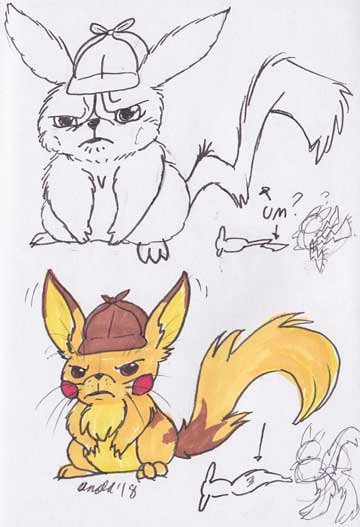
Speaking of fictional creature redesigns, here's my silly attempt to give Detective Pikachu less... *jarring*... anatomy:

11.13.18 - Detective Pika

But also...

-------

Okay, here are the new After Man illustration spoilers.  Note that both the original and revised illustrations are credited to Diz Wallace:


So the new Reedstilt is fine.  Weirder than the old design, which was already deeply strange to start with.  I don't like it as much; the old version is a lot more graceful.

Okay hang on to your butts, here comes the new Nightstalker:


Okay, it's redder.  And more... sinewy...  I'm not a fan, but I admire the stones it takes to redesign one of the very few creatures in After Man who can truly be called iconic

Friday, December 3, 2010

Obscure Dougal Dixon Stuff!

I hate it when I can't think of anything to blog about. But then I love it when something incredibly mention-on-my-blog-worthy falls into my lap when I can't think of anything to write about. (I only wish it would happen more often before Noon instead of after Midnight.)

So sometime last week, the very good and bookmark-worthy real science and science fiction news site io9 ran an article about Dougal Dixon's saddest speculative creatures. (Yes, our old friend the Slobber is among them. Can't believe they didn't mention the Wyrms, but read on.) The article is a slideshow of images, so there are some good scans from Dixon's books. I believe most if not all of the art is by Diz Wallace.

They make up for not mentioning the Wyrms by having creatures from Man After Man
take up nearly half of the list. (Yes, I did find Sivatherium's scan of the book, no I still don't want to revisit it. I will, however, share this intriguing page from The Alien Life of Wayne Barlowe, for those who dare to read Sivatherium's scans. It is... thought-provoking to say the least.) I'll warn you, the slideshow is bookended by the most disturbing of the images from the book. You'll see in an instant as to why this book freaked me the f*** out when I was a child.

Now, nostalgia for Dougal Dixon's books is definitely high in certain circles, but the books are so obscure that they rarely get any mention at all in websites with any popularity. So if there's anything I can't pass up, it's a discussion thread under any and all articles mentioning Dixon's speculative biology books. This one is pretty lively (other people remember the "Future Zoo" exhibit!) and the posters shared quite a few Dixon projects that I was not aware of.

In the introduction to
The New Dinosaurs, Desmond Morris wrote that he hoped that Dixon's next work of speculative fiction would take place on an entirely different planet. An alien ecosystem "where a parallel evolutionary process has taken place, guided by the special environmental conditions that exist there. In Dixon’s safe hands, what a wonderful safari that could be." (So how disappointed do you think he was with Man After Man?) It turns out that Dougal Dixon actually did write a book about an alien world called Greenworld. It's a somewhat satirical look at what happens when humans colonize the unsuspecting titular planet. The illustrations have a definite whimsical feeling reminiscent of the classic Spec-Bio book, Snouters, and many of them can be viewed in this blog post. And this book is... only available in Japan. Wah.

Speaking of Japan, apparently Dougal Dixon's creatures have a very intense cult following there. I do remember hearing something about a theme park(?!?) based off "The Future is Wild" over there. Check out this brief Anime musical number featuring the animals from from After Man. I have no idea whatsoever what this is about. There are many times when I wish I had any chance of successfully learning another language as quickly as possible and you'll see why this is one of them:


There was also a whole
After Man documentary series that ran only in Japan. This is the first I've ever heard of it so I know literally nothing about it. YouTube user Manafterman has kindly uploaded the whole thing in parts.

I'm going to embed this highlight reel which shows off what we all came to see: the creatures (including an oddly hypnotic scene of Parashrews doing their wonderfully unlikely namesake thing). Note the combination of eerie puppets and funky, Harryhausen-esque stop motion.

There is also a very weird sequence near the end where Dixon shows us his take on the good old Dinosauroid concept (for those who are new to speculative biology, this is a very old concept that refuses to die and maybe deserves a post in the future, although Tetrapod Zoology has already done an excellent job covering it.) It's especially odd as there is no mention of any creatures of humanlike intelligence in After Man -- except in the very, very end, where Dixon speculates that if humanlike intelligence were to ever be seen on Earth again, it would be in either the insectivores, the corvids, or the parrots. Seems he liked the parrot option best. Now, I'm glad Dixon's Dinosauroid isn't too anthropomorphic (glares at Dale Russell). And I'm happy that he looks very
very different from other Dinosauroids out there. But boy howdy this creature design is going to haunt our post-Thanksgiving dreams. Also, leg/arm:


Speaking of offbeat and only vaguely anthropomorphic speculative creatures of humanlike intelligence (whew), another wonderful Dixon gem was shared by poster Hypnosifl. It seems that long before
Man After Man, Dougal Dixon did a feature on what humans might possibly look like in the future for the November 1982 issue of Omni. It was less nightmare fuel-y and more...

I am going to use the very scientific term Balls-Out Insane to describe them. Hypnosifl was happy to share scans of the article with us and...


😱

Wow.


WOW.


Here's the text portion: Part One, Part Two, and Part Three. And here are the full page illustrations: Future Human, More Future Humans (NSFW warning: there's one part on the floating brain guys that hasn't atrophied... ), and Future Birds (including a Future!Wyrm). On that last note, I enjoy the idea that birds will get another fun experience of being post-apocalyptic survivors. This find was so crazy that io9 did a follow-up post about it.

I think we may need a few of these after that one.


-----

I have another craft fair this weekend! That means I might not be able to update until Tuesday, but I think I may have found something interesting from another offbeat natural history author I've previously reviewed...

Friday, October 2, 2009

Megafauna's Back Baby! Let's Continue Reading _After Man_!

We're taking a tour of Dougal Dixon's classic sci-fi biology book, After Man, A Zoology of the Future, which envisions a world fifty million years after all modern large animals go extinct. Read the first half here.

Now, as I said before, this book was published in 1981, and it's animals were probably invented long before that. The science is a little dubious when seen through modern eyes, but for the most part, the artwork is still very good and most of the fictional animals are just plain cool-looking.


I said MOST of them!

Illustrations by Diz Wallace. Now, this wouldn't be a book review by me if I didn't point out a few weird and or... unpretty creature designs. The shrew-descended Tree-Drummer and Reedstilt (like the infamous Wyrm) don't really make any damn sense unless there are absolutely no animals more qualified to fill these niches. There
are tree-boring birds and long-necked fish-eating birds in the world of After Man so...


Illustration by Diz Wallace. As I said in the previous post, we can't play the Dixon Drinking Game unless we change the rules a little, as there are very few animals who sport rolls of fat. Here are the Turmis, a kind of pig-elephant, and they will be your unlikely ant-eating species for this evening.


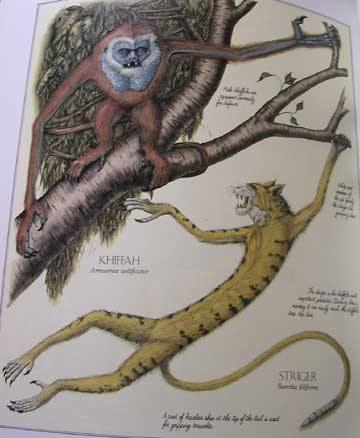
The happy fellow in the upper-right of this illustration (once again by Diz Wallace) is the Khiffa, and he and his colony will be your unlikely colony-dwelling species for the evening.
 

And dig the Striger; a creepily anthropomorphic climbing cat.


The Tusked Mole is the first of a few animals whose lifestyle might not have been thought out all that well. I would have thought tusks that stick straight out of your face would get in your way while digging.


The Night Glider is similar in that respect. It's essentially a predatory flying squirrel, dropping silently on it's prey from the 'bove (A). Unfortunately, gliding animals can't really fly without a leaping start and cooperative winds, so I'm not sure what the Glider's supposed to do with it's prey after succeeding in securing it (B).


And now, the saddest imaginary animal ever.


Illustration by Diz Wallace again. Man, how did
that conversation go? "You want me to draw the saddest imaginary animal ever? OK!" 

The Slobber is a creature that does exactly what you see her (yes, her; that thing clinging to her stomach that looks more like it's sticking out of it is her baby) doing all day long: catching insects with her drool. This is not a pretty mental image.

And then, there is the infamous Parashrew:


I have nothing at all to add to this, so bring on the Giant Penguin-Whales!!!


Diz Wallace yet again. "WHAT?!?"


Hell, I love the Pelagornids and the Parashrew. The sheer ridiculousness of these animals is impressive. For one thing, I've seen the B.S. penguins need to deal with every spring. You gotta figure that if penguins were ever going to develop the ability to bear live young instead of laying eggs, they'd have done so by now. I also like the fact that a whale-penguin is right out of "Avatar: the Last Airbender".


I can be as sarcastic as I like, but
After Man is a classic of it's genre. It has had a lasting influence on myself and anyone else who has ever wondered "what if?"

Plus it kicks the stuffing out of "The Future is WAAAY Too Trippy Wild".

----

Totally unrelated, but you may have started to see the TV spot for "The Princess and the Frog" last week. If not, it looks like this, but shorter (embedding is disabled). Now... I'm on good authority that the full film is better than this looks, and I desperately want the film to be better than this looks (it's absurdly unfair that so much should be riding on this one film). But is anyone else getting a nasty "Rock-A-Doodle" vibe from this teaser?

Wednesday, September 30, 2009

The Humans Are Dead, But There Are Jackalopes Now! Let's Read _After Man_!


I'll warn you right away, my nostalgia filter may be strong with this one. Indeed, you may run into many science fiction fans / armchair biologists / creature designers / ect. around my age whose young minds were permanently blown by Dougal Dixon's After Man. The New Dinosaurs, in hindsight,
might actually be better, but I find it very hard to have many bad things to say about After Man and it's various creatures. As the delightfully named Caustic Cover Critic says, the book is "deeply odd and quite fascinating."

After Man
was first published in 1981 (and the creatures were likely invented well before that, so take the science with a grain of salt), but I first learned about it through one of the Museum of Science's stranger traveling exhibitions. It was called "Future Zoo" and it was essentially a walk-through version of the book, with paintings on display, sculptures and animations of the animals, and even a robotic Desert Leaper (a la those wonderful traveling robotic dinosaur exhibits). Sadly, there does not appear to be any information about it online, so I have to go by my foggy memories. The exhibit was really the first work of hard science fiction that spoke to me as a child, and once I learned there was a book I HAD to have it.

Flash-forward nearly
ten, maybe even fifteen years to the frabjous day when I spot this, totally randomly, in a random gift shop:


Now of course I bought this on the spot. All told, I've only seen two copies of this book in person. Sadly, they were both incredibly cheaply bound softcovers. Before I start giving you the tour through the book and post more pictures, I need to show you what condition my copy is in now:


Illustration by Gary Marsh. Talk about loved to death. Long out of print, Dixon's books are notoriously hard to find nowadays and known copies tend to be expensive. Here's the Amazon link if you'd like to try your luck.
 

Anyway, the introduction of the book serves mainly as a refresher course of basic evolutionary biology. It also reminds us that many of the animals around today had ancestors that would be completely unrecognizable to us.
 

This will prove to be foreshadowing, as the world in After Man is one that had been long ago inherited by the meek. As the title suggests, the humans are dead. So are all the other animals human-sized and larger. The world is very different now, after all the large animals went extinct fifty-millions years ago in the early 1980's.
 

This kind of thing comes with the territory of setting a book in the future. Just go with it.
But with that said, you have to remind yourself what most science fiction dealing with future evolution was like prior to
After Man. Typical scenarios include things like, "humans will keep getting smarter and smarter but they will also have terrible powers and be evil!" "There will be all kinds of giant monsters with big teeth and claws and blah!" And the good old chestnut, "radiation will cause normally innocuous animals to mutate and try to kill everyone!" Come to think of it, that last one is still around in full force; just replace "radiation" with "genetic engineering" (or, frankly, "writers who failed biology").
 

That's why After Man was so refreshing. It was also the first time many of us saw imagined animals treated with utmost respect and painted as if they were real. Here's one of the first illustrations in the book, introducing two major groups of future animals, the Rabbuck and Predator Rats, and it's still awesome:


Illustration by Diz Wallace, affectionately parodied here. This is how you illustrate creatures that don't exist. (Though it is a huge missed opportunity that the Rabbucks are not actually called jackalopes.) I wouldn't be surprised to see this exact scene in a real Victorian-era natural history book.


Illustration by Philip Hood. We've met two of the three major groups of animals in the previous illustration (the Rabbucks are large deer-like animals descended from rabbits and the Predator Rats are... exactly what it sounds like.) These Hornheads are in the third group, the Gigantelopes. Only the very small hoofed mammals like caprids survived into the future. I just like these guys because I have a soft spot for moose, sheep, and hadrosaurs.


Illustration by Philip Hood. Here's the lovely Desert Leaper, essentially a gigantic jerboa who has filled the niche left wide open by the camels. For those of you playing the Dougal Dixon drinking game, note that this guy is one of maybe three animals in the book that displays (ahem)...


Now let's meet the fellow alluded to in the beginning, Nightmare Fuel on Legs the Night Stalker, a predatory flightless bat.


Illustration by Diz Wallace. This illustration found it's way into several other sci-fi books and (subconsciously at least) into a number of character designs.
 

Gosh, this is already getting to be longer than I expected. Let's stop here and meet more of the animals in Part Two.
 

And here's the old Tetrapod Zoology post that got me thinking about Dixon's books again.
 

And, hey, it's Banned Books Week! I'm sure After Man has been challenged at one point or other. Or it would be if it were less obscure - which is one of the things about the Challenged Book List that gets me. (It seems a book isn't controversial until it gets popular or attention in the mainstream media. Note that it took a while for His Dark Materials to crack the top ten.)
 

And for the love of Benji, people. They're PENGUINS. (But I'm suddenly curious to know how, exactly, these penguins are also "anti-ethnic". WTF?!)