Showing posts with label Field Guide. Show all posts

Friday, April 15, 2011

We Just Keep Reading _The Macmillan Illustrated Encyclopedia of DINOSAURS and Prehistoric Animals_!

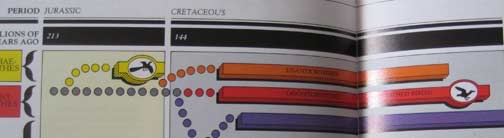
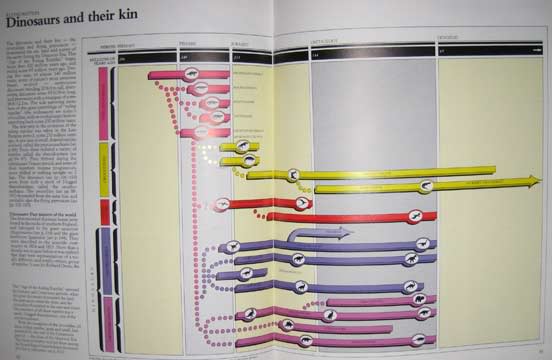
And today, finally, 80's dinosaur goodness from that awkward era of paleoart immediately following the publication of Dinosaur Heresies. And I didn't realize this until just now, but knowing that Dougal Dixon had his hands in this book helps to explain certain... oddities in The New Dinosaurs. To wit, classification:

The Macmillan Illustrated Encyclopedia of DINOSAURS and Prehistoric Animals

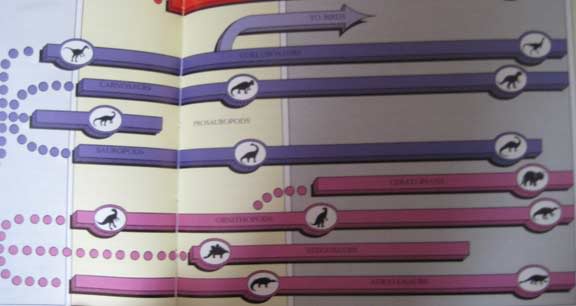
Let's zoom in a little:
The Macmillan Illustrated Encyclopedia of DINOSAURS and Prehistoric Animals

Note that the little Theropods don't even appear to be related to the big Theropods at all (at least the arrow that leads "to Birds" is very definitely emerging out of those little theropods). Look close and you'll also see what can only be described as a "retro" Iguanadon and a couple of sauropods in the classic space-saving "neck curled back over body, tail curled forward beside body" pose (can anyone from SV-POW who may happen to read this let me know if that is even anatomically possible?)
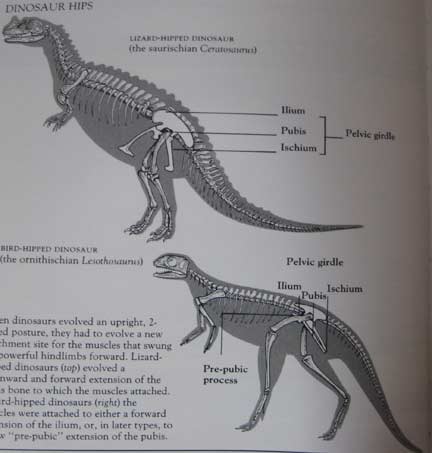
The Macmillan Illustrated Encyclopedia of DINOSAURS and Prehistoric Animals

Before the dinosaur section really gets rolling, we get these two skeletal drawings to explain Ornithischians and Saurischians. Oh gosh, those tails...
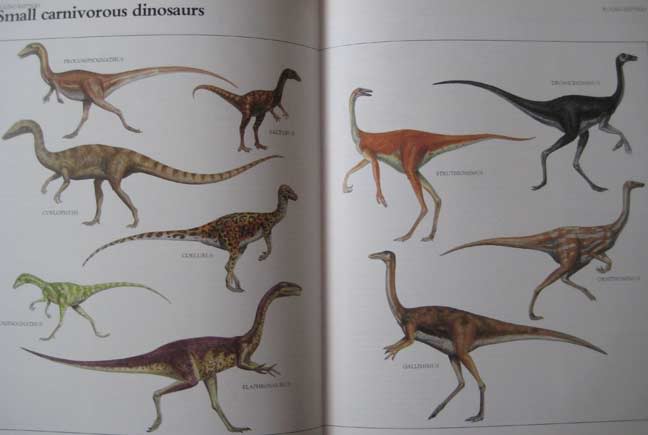
The Macmillan Illustrated Encyclopedia of DINOSAURS and Prehistoric Animals

So here's our first group of, er, "Small Carnivorous Dinosaurs". Elaphrosaurus was thought to be some kind of early Ornithomimid back then.

And then, things get weird:
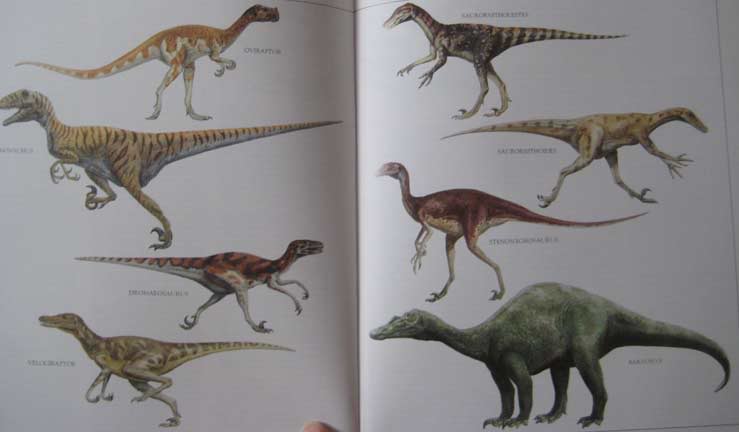

The Macmillan Illustrated Encyclopedia of DINOSAURS and Prehistoric Animals

80's Maniraptors! I'm gonna say it. I'm gonna say it. Naked maniraptors look stupid. And note the improbably skinny little kangaroo hands on Deinonychus.

And WTF is Baryonyx doing there? Why is he on all fours? Man, no wonder people were surprisingly likely to confuse spinosaurs and pelycosaurs back then.

Except...
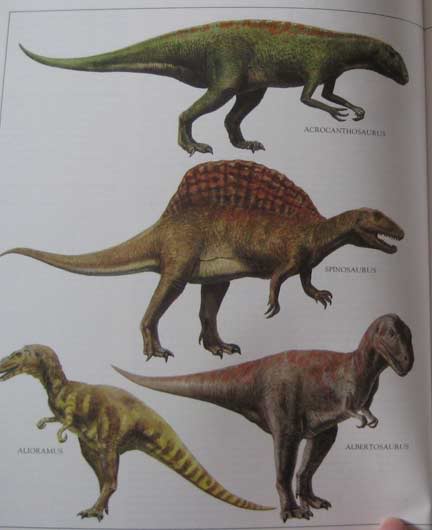
The Macmillan Illustrated Encyclopedia of DINOSAURS and Prehistoric Animals

Except here's Spinosaurus, and he is apparently a close relative of Acrocanthosaurus. Because they both have big spines, you see. Also, it looks like they are both Tyrannosaurs, because they are large.

What?
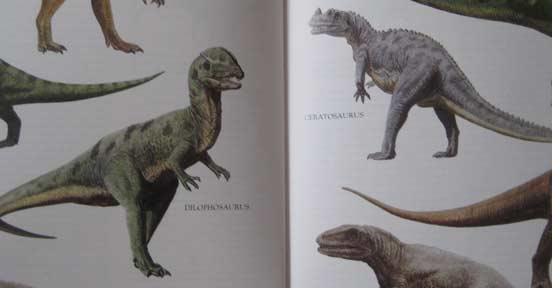
The Macmillan Illustrated Encyclopedia of DINOSAURS and Prehistoric Animals

Here's another big, burly Dilophosaurus, in among his fellow large Carnosaurs (including a
really Kaiju-esque Ceratosaurus). Anyone know what the deal is with these burly Dilophosaurs?
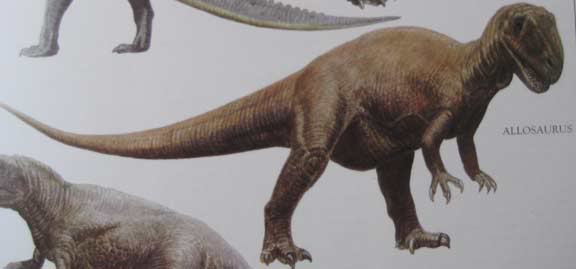
The Macmillan Illustrated Encyclopedia of DINOSAURS and Prehistoric Animals

A very 80's Allosaurus. Very, very different from what we're used to now, but every big theropod in this book looks essentially like this; no cool horn bosses or feather spikes or bright colors or anything.

That's not to say the whole dinosaur chapter is a gauntlet of Real is Brown. Now, normally the feathered maniraptors would be the only animals to be colorful. But since Birds is Birds, there's no potential for Sparkleraptor sightings.

Instead, we get Sparkleornithischians:
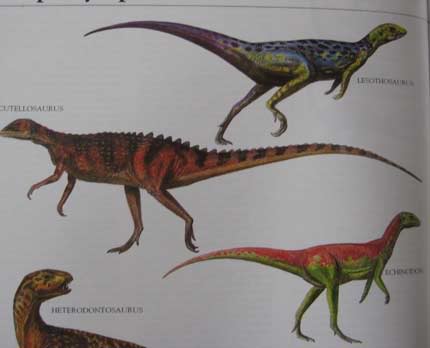
The Macmillan Illustrated Encyclopedia of DINOSAURS and Prehistoric Animals

The Macmillan Illustrated Encyclopedia of DINOSAURS and Prehistoric Animals

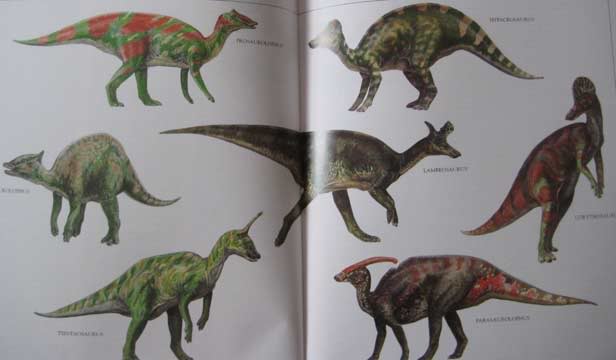
So pretty! I like the tie-dye patterns on the hadrosaurs. Also note that little "insert back of horn here" notch on Parasaurolophus.
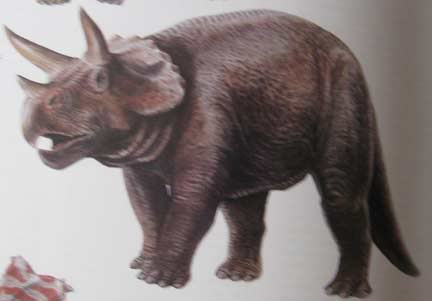
The Macmillan Illustrated Encyclopedia of DINOSAURS and Prehistoric Animals

There's nothing half as exciting as that in the rest of the chapter. This Triceratops looks a little odd to my eyes. Like a *just* borderline McLoughlin-ceratops.

The Macmillan Illustrated Encyclopedia of DINOSAURS and Prehistoric Animals

You can almost hear her crying, "Oh for goodness sake, the readers know that!"

So basically,
The Macmillan Illustrated Encyclopedia of Dinosaurs and Prehistoric Animals is a good book for the time it was written. Oddly, the Encyclopedia was published again in 1999 under the title The Simon and Schuster Encyclopedia of Dinosaurs and Prehistoric Creatures. And this new book contained several new illustrations... but only for newly included animals. Everyone got the same illustrations as in the older book and mostly the same text (Baryonyx is even still a "raptor"). Kind of a cheap move for a book that deserves a fully revised and updated edition.

----


Art of the Day!

I made my own Sparkleornithopod!
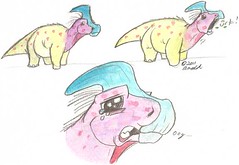
3.29.11 Sketchbook Page

Wednesday, April 13, 2011

Let's Continue Reading _The Macmillan Illustrated Encyclopedia of DINOSAURS and Prehistoric Animals_!

The Macmillan Illustrated Encyclopedia of DINOSAURS and Prehistoric Animals

As stated in part one (hit "Older Post"), The Macmillan Illustrated Encyclopedia of DINOSAURS and Prehistoric Animals set out to illustrate every fossil vertebrate yet known circa the late '80s. What it doesn't do is dedicate much text to the animals included. And some animals need more love.

Take the Pareiasaurs seen above. No, they aren't dinosaurs. They're a group of Permian Anapsids, and as such their only famous relatives are turtles and tortoises. (This may give some of you non-nature-geeks a headache but turtles, as it turns out, might not be closely related to any other modern reptiles. Should be noted that Class Reptilia might as well be retitled, "Animals Charles Linneus Did Not Like".) The Encyclopedia gives no information about these animals other than basically, "They were big herbivores with four legs and they had big bumps on their heads." Yeah. Could never have guessed that.

The Macmillan Illustrated Encyclopedia of DINOSAURS and Prehistoric Animals

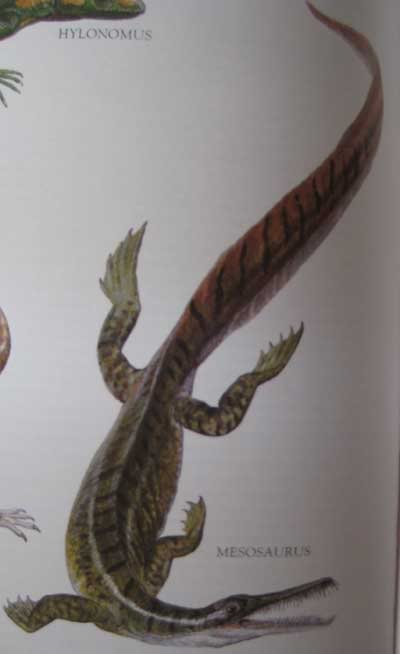
We've got a very wide variety of animals to see today so let's stay in Anapsida for now. This is a Mesosaur, and I really like him. Look how cute he is. I have a soft spot for water animals and Meso here is stated to be the first land animal who "returned to the sea". In fact, I think Mesosaurus has the most text of any animal we've looked at in this book! Nothing particularly interesting; he was long-bodied but small (about three feet long) and probably lived like an otter.

The Macmillan Illustrated Encyclopedia of DINOSAURS and Prehistoric Animals

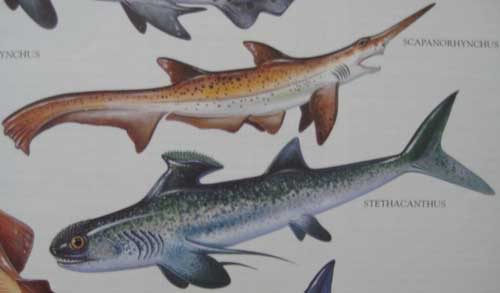
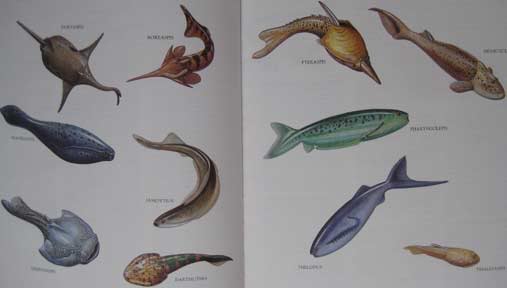
From cute aquatic reptiles, I take you now to weird fish. These are two Elasmobranch fish, and fellow frequent "Science... Sort Of" listeners probably already know that this is the big clade to which sharks and rays belong. Scapanorhynchus is a shark from the Cretaceous period and probably lived like modern Goblin Sharks. Stethacnthus is a much, much older fish from the Devonian, and that thing on his fin was some kind of threat display.

The book demonstrates very vividly that the shark is the grand jury prize winner in the grand game of evolution. Single genres of shark (like the famous Hybodus, which looks rather like a bigger Spiny Dogfish) last for more geological periods than whole orders of four-legged animals do!

The Macmillan Illustrated Encyclopedia of DINOSAURS and Prehistoric Animals

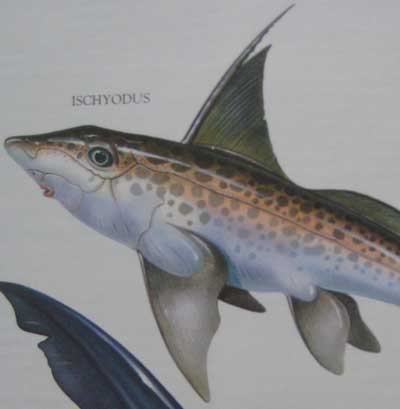
Ischyodus is a member of the other group of cartilaginous fish, the Chimaeras. Just have to point out one thing: this fish has some creepy lips.

The Macmillan Illustrated Encyclopedia of DINOSAURS and Prehistoric Animals

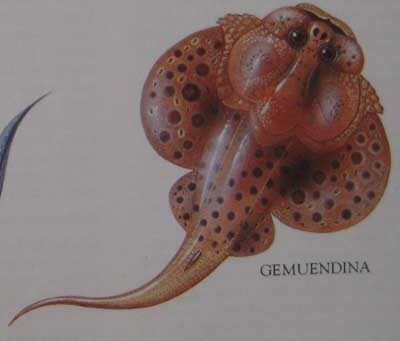
Our last fish is from the extinct fish group, the Placoderms, or "Armorsharks" thanks to their armored skin and the fact that their most famous member, Dunkleosteus, was nightmare fuel on fins. This Placoderm is Gemeuendina, a bottom-dweller remarkably similar to modern rays and flounders, and that FACE!?! (See also...)

And with that, we move on to amphibians. Amphibians are cute, right? Right?

The Macmillan Illustrated Encyclopedia of DINOSAURS and Prehistoric Animals

OK, seriously. This is Gerrothorax, and it was a big, flat, gill-retaining amphibian whose relatives either all died out in the Jurassic or gave rise to today's frogs and toads.

The Macmillan Illustrated Encyclopedia of DINOSAURS and Prehistoric Animals

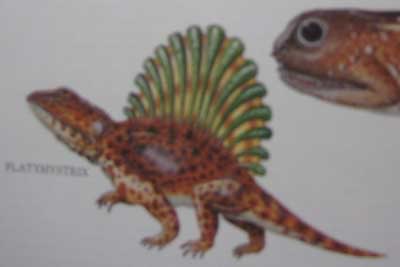
Platyhystrix is another member of this clade and it was a contemporary of more famous Synapsid sail-havers like Dimetrodon and Edaphosaurus. Unlike those animals, Platyhytrix's sail is apparently a really weird kind of armor. And speaking of weird armor...

The Macmillan Illustrated Encyclopedia of DINOSAURS and Prehistoric Animals

Diplocaulus! You may recognize this creature. They were in an episode of "Dink the Little Dinosaur" once. Let us not speak of it again.

I know you're impatient, so let's show a few dinosaurs before next post...

Or not, because it is 1988 and birds is birds. See, this book says so:

The Macmillan Illustrated Encyclopedia of DINOSAURS and Prehistoric Animals

Yeah. Like the primates, the birds suffer from an unfortunate change in art styles too:

The Macmillan Illustrated Encyclopedia of DINOSAURS and Prehistoric Animals

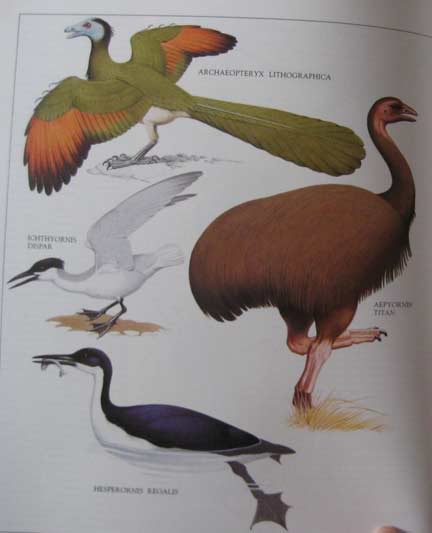
What you're looking at here is essentially the be-all and end-all of prehistoric avian diversity, circa the 1980's. Something like little Sinosauropteryx would have totally broken everyone's mind back then.

The Macmillan Illustrated Encyclopedia of DINOSAURS and Prehistoric Animals

The Macmillan Illustrated Encyclopedia of DINOSAURS and Prehistoric Animals

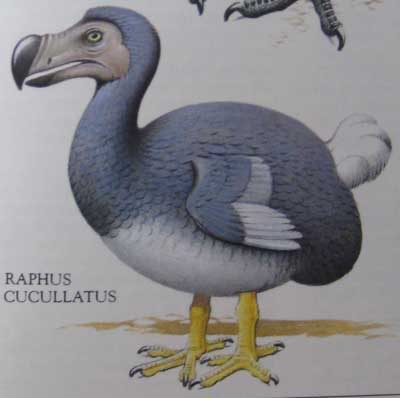
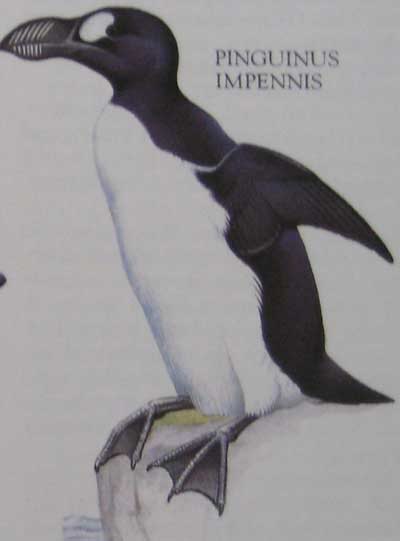
And in case you woke up happy this morning, here's today's reminder that Humans Are Bastards. Which is surely the only reason why the Great Auk and Dodo are included as neither of them are, strictly speaking, prehistoric.

Addendum: And in case you are still having a good time after that, here's a recent article about the Dodo that pretty much tells you everything you need to know about people's attitudes towards animals back then.
On to Part Three: 80's Dinosaurs!

----

It seems James Gurney was in Boston very recently. He visited Club Passim and The Harvard Museum of Comparative Zoology. The HMCZ is probably my single favorite place to sketch so It's awesome to see it get Gurney's approval.

Also, this happened. This means war!

----

Sketch of the Day!

4.3.5.11 Sketchbook Page

Monday, April 11, 2011

Let's Read _The Macmillan Illustrated Encyclopedia of DINOSAURS and Prehistoric Animals_!

The Macmillan Illustrated Encyclopedia of DINOSAURS and Prehistoric Animals

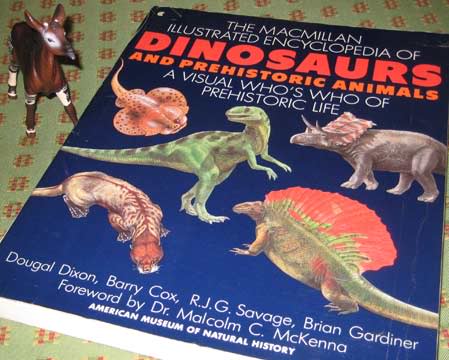
When I was but a wee lass in the early 1990's, I lusted after what I thought would be the be-all and end-all of prehistoric animal books: The Macmillan Illustrated Encyclopedia of DINOSAURS and Prehistoric Animals. The many, many authors - including our old friend Dougal Dixon - are listed on the front cover. The illustrators are Colin Newman, Steve Kirk, Malcolm Ellis, Graham Allen, Andrew Robinson, Andrew Wheatcroft, Steve Holden, Vana Haggerty, and "Grundy & Northedge".

It's a little hard to explain the magnitude of this book in my imagination at the time. Information about prehistoric creatures wasn't as readily available as it is today (remember, the very idea of using a computer for anything other than writing essays and playing "Tetris" was absurd). I associate this book with the crazy times just after "Jurassic Park" - I don't even recall buying this book (at, according to the lovingly preserved price tag, the Museum of Science gift shop for $24.95) until maybe 1996.


So imagine my amazement when I finally looked at the publication information this time: it's copyright 19
88 by Marshall Editions Limited. In other words, as I've mentioned before, this is a book from that incredibly awkward time immediately after Bob Bakker published The Dinosaur Heresies (it has just occurred to me that every time I mentioned Heresies, I assume it doesn't need an introduction to the audience I've built up. I know you guys). The difference is that it is one of the few fully illustrated books from that time.

The Macmillan Illustrated Encyclopedia of DINOSAURS and Prehistoric Animals

And the scope of the book is ambitious as hell: every fossil vertebrate found to date, given a loving life reconstruction. Naturally, the dinosaurs command all the attention, but we'll talk about them (well, technically
most of them...) on Friday. They are, however, hardly the most interesting animals in the book. Honestly, even in 1988 there was already a ton of ink spilled on the new theories of dinosaurs -- and almost no popular natural history books explaining the strange fish you see before you on these pages. Really, this book often just made me more curious about animals I'd never heard of and frustrated because there was (and still is, frankly) little information to be found, and that's what we'll focus on today and Wednesday.

A word about the format of this book: it follows a format I've seen in some other natural history books: Two pages of full-color illustrations followed by two pages with maybe a paragraph or two of information about the animal, where and when it lived, what it ate, and (in an act of arguable redundancy) what it looked like. And this is sad, because some of the animals demand to be elaborated upon.

The Macmillan Illustrated Encyclopedia of DINOSAURS and Prehistoric Animals

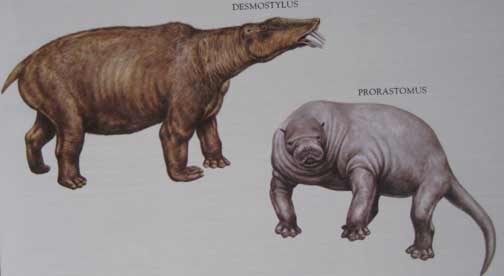
None more than Desmostylus. Holy cow, look at that thing! The book helpfully explains that "it must have looked and acted like a modern hippo", when what I really long for is a skeletal study with a detail of that strange head and some idea of what (if any) modern animal it's related to.

The same goes for the Prorastomus, simply identified as an "early Sirenian". The book also notes that this reconstruction is mostly speculative, leading us to wonder why a manatee ancestor would have such a skinny tail and big burly hind legs. Really, I would love to see an updated field guide to fossil mammals, since some of them are begging for attention.

The Macmillan Illustrated Encyclopedia of DINOSAURS and Prehistoric Animals

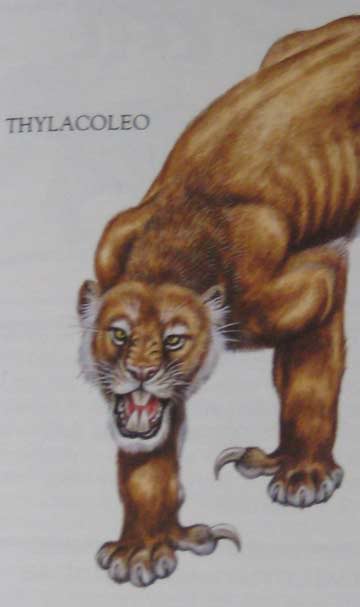
Like Thylacoleo. He's described here as a "marsupial lion". What that means is that he is a marsupial from Australia that converged onto big cats, much like the comparatively less obscure Thylacosmilus from South America and the remarkably dog-like Tasmanian Thylacene. Thylacoleo really did have sharp, fang-like incisors, though they probably weren't as goofy as they look here. What I'm wondering about here are those giant thumb-claws; it's like the real-life equivalent of all those fictional species on DeviantArt who have "Raptor claws" for some dang reason.

The Macmillan Illustrated Encyclopedia of DINOSAURS and Prehistoric Animals

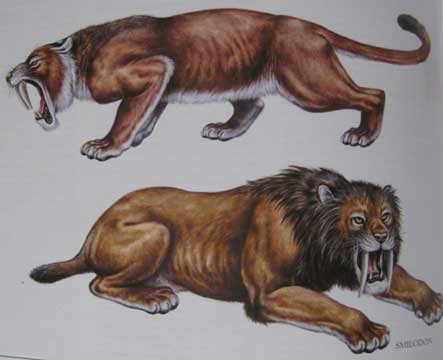
As for the real cats, I like how the famous Smilodon is just chillin', rocking a bad-ass lion mane. Eusmilus, the sabretooth above him, looks like he is ready to murder everyone.

The Macmillan Illustrated Encyclopedia of DINOSAURS and Prehistoric Animals

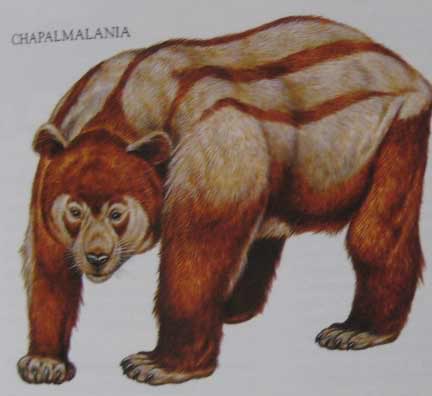
Prehistoric mammals don't readily lend themselves to gaudy color schemes, since, all evidence from DeviantArt aside, there aren't many gaudy colorful mammals running around today (that were
actually born that way, like with purple fur and such). The Macmillan Encyclopedia does what it can, though. This is Chapalmalania, who is described as a giant... raccoon. Because back in '88, there was still a lot of debate as to whether Panda Bears were indeed bears or some kind of giant raccoon. I have no idea where this leaves our poor StripeyBear today.

The Macmillan Illustrated Encyclopedia of DINOSAURS and Prehistoric Animals

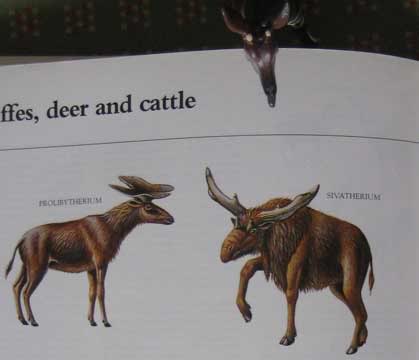
Often in the Encyclopedia, you'll have illustrations of a plethora of extinct animals that look nothing like their more familiar modern relatives and one or two that do. I'm glad they avoided that for the giraffes.

The Macmillan Illustrated Encyclopedia of DINOSAURS and Prehistoric Animals

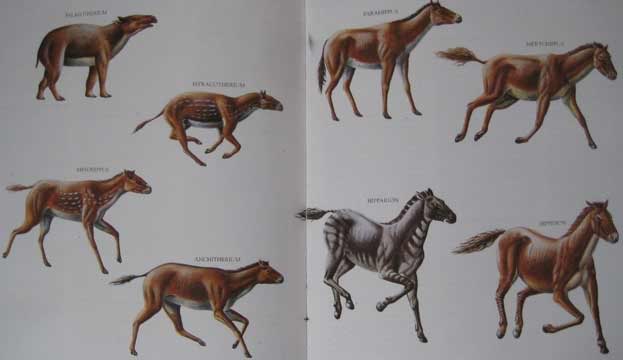
Here's your Semi-Requisite Early Horse Sequence.

The Macmillan Illustrated Encyclopedia of DINOSAURS and Prehistoric Animals

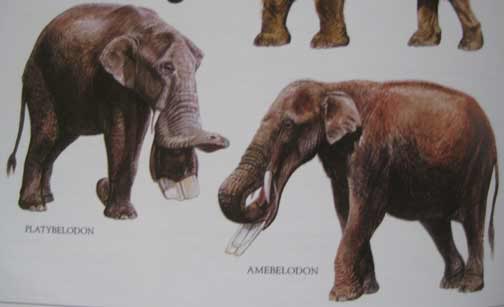
And a pair of "shovel-tuskers". I've always found these elephants fascinating, and I regret not giving them a proper tribute when the opportunity came up earlier this year.

Now, up until this point the paintings have been in a fairly consistent style.

The Macmillan Illustrated Encyclopedia of DINOSAURS and Prehistoric Animals

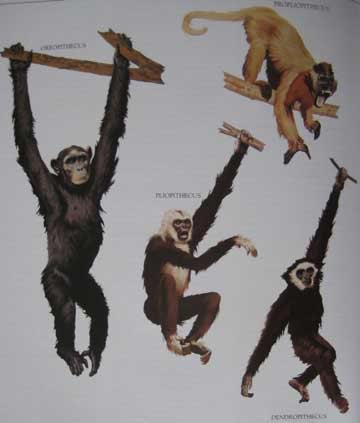
But then there is a sudden art shift when we hit the primates. Who knows why, and from the look of it, that Propliopithecus in the upper-right corner thinks of nothing but sex and violence all day.

Been a little unusually mammal-biased today, haven't I? Well, I'll focus on a wider variety of animals in the next post. Until then, think of nothing but sex and violence all day; it's and old primate tradition after all.

On to Part Two!


----

Sketch of the Day!

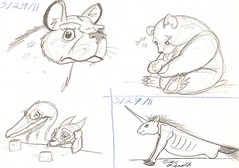
Random coffeeshop animals:

3.24-27.11 Sketchbook Page