We're in the home stretch now. After this, there are only three movies left.
And if anything, "Bambi 2" reminded me that the smartest thing I did before launching My Summer of Sequels was to prune a few titles off the queue and only concentrate on the Disney DTV sequels that are supposedly not so terrible. (Though it turns out that they are, in fact, pretty terrible anyway.) The DVD for "Bambi 2" includes trailers for *both* "Beauty and the Beast" sequels (along with another DTV sequel I've already forgotten about), and given the eye-bleeding animation and "yeah, f**k this" voice acting, I saved myself a lot of misery.
Honestly, the special features included in the "Bambi 2" DVD are more interesting than the movie itself. Out of curiosity, I checked something called "Disney Sketch Book" and was flabbergasted to see that it was a very brief interview with Andreas Deja. Yes, Andreas "If animators are actors with pencils, he is the Robert DeNiro of Disney" Deja is interviewed in a special feature on the "Bambi 2" DVD. (It is a feature that is clearly for young children, and he briefly talks about the importance of drawing all the time if you want to be a good artist.) It's... jarring. Apparently, Deja was brought into DisneyToon studios to give the animators there a crash course in animal anatomy. As a result, the character animation in "Bambi 2" is pretty lush compared to that of most other sequels I've seen. So it has that going for it; which is nice.
So. "Bambi 2". It's the Disney sequel that was rather remarkably in hindsight predicted by this (slightly NSFW) memorable "Saturday Night Live" animated short from 2001. And that short is especially impressive for it correctly predicts two significant things about "Bambi 2".
First, "Bambi 2" isn't really a sequel at all. It has the dubious honor of being the Disney DTV sequel that introduced the terms "interquel" and "midquel" into the world; sequels that take place during the original movie. Now to be fair, this concept is not new to Disney DTV sequels. "The Lion King 1.5" takes place during the original story. So do the aforementioned "Beauty and the Beast" sequels. But somehow setting the sequel to "Bambi" during the original story is especially irritating and almost insulting.
Maybe it's because there was a good 64 years in-between "Bambi" and it's midquel and it's hard to think of what deep unanswered questions people may have had about the events of the film in all those decades. Maybe it's because there's a sequel to the original printed-page Felix Stalton Bambi, Bambi's Children, so there's the question of why, if they felt the need to do a "Bambi" sequel, they didn't just make an adaptation of that. And maybe especially, it's because as with the "Beauty and the Beast" midquels, it's crystal clear how shameless these DTV sequels are. The most obvious reason why they are set during the original story is so that they can show major characters in their much more marketable forms (the servants as Enchanted Objects, Bambi as a cute little fawn, etc.)
Secondly, and perhaps more significantly, the SNL short predicted when "Bambi 2" would take place during the original story: right after That One Scene. You know, That One Scene that comes up anytime you try to talk about "Bambi" as arguably the most significant and game-changing early Walt Disney animated feature with adults who, it quickly turns out, have not watched it in a while. Specifically, they have most likely not watched it since the one time they saw the film in childhood, when their well-meaning parents shut the tape off after That One Scene. (Major tangent from the child psychology minor: Although your deep-seated instinct tells you to take your child away from whatever is making them cry, and although I will be the first to admit that the situation would be very different in a crowded theater, surely the best way to deal with a sad/scary moment upsetting your child in a work of fiction is to have your child stop experiencing that work of fiction right there, during the sad/scary moment, making that moment the last thing they'll ever remember from it and not getting to see the subsequent resolution and happy ending. Yes I have thought about this a lot. Yes it really bothers me.)
Anyway, "Bambi 2" begins immediately after, as so wonderfully cynically worded in "Friends", "The guy stopped drawing the deer". And it's only discernible reason to exist is, I guess, to show us that Bambi was not immediately abandoned by his father after they both walk away in the snow. As far as the other deep unanswered questions addressed by "Bambi 2", we learn that somehow wild forest animals are aware of Groundhog Day (just... what?), that the California Quail are still hanging out in the implicitly Maine woods (an admittedly nice continuity nod), and that Bambi and Faline met Ronno the rival stag as a fawn, which actually makes their encounter as adults in "Bambi" more awkward.
Now if I had it in me, I'd talk a little about how the characters in "Bambi 2" are suddenly very like their rough equivalents in the original "The Land Before Time" (which is funny as "LBT" was dismissed in many negative reviews as "a prehistoric 'Bambi'") to the point of paraphrasing or even directly quoting them. Speaking of, if I had it in me I'd talk about how the original "Bambi" famously had less than 1,000 words of dialogue in it's entirety while the characters in the midquel never shut up ever. And oh, if I had it in me, I wish I could get into the long long and fascinating discussion of how, given that there are sixty four years of animation history and technological advancements between them, it's not even fair to compare the animation in "Bambi 2" to that in it's predecessor, where everything was done by hand by a team of people who did not have the luxury of sixty-four years of animation history and technological advancements behind them, and were basically flying by the seats of their pants.
I... don't have it in me. To busy bracing myself for the next sequel.
-----
Sketch of the Day!
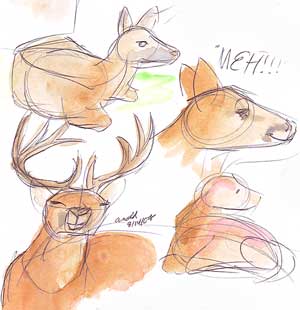
Oh, deer.