Well, here we are already at the final set of "Fraggle Rock" DVDs. I didn't think we'd be here so early and I'm already feeling pretty down, knowing that the end is near. Sadly, march on towards the final episodes we must, although we need to talk about network scheduling weirdness first.
The final twenty-four episodes of "Fraggle Rock" were produced as one final season. In America, HBO ran the first half of that last season as "Season Four", then ran the second half the next year as "Season Five". I'm going to ignore all this and just refer to the last season as Season Four, partially out of convenience, and partially because, upon review, the first half of this season set is... I'll be very nice and call it a bumpy ride.
And I say that with full knowledge that even at it's worst, "Fraggle Rock" is still the very best children's television program ever produced. A bad episode of "Fraggle Rock" is still a damn sight more fun to watch as an adult than a good episode of "Johnny Test" after all. But a bad episode of "Fraggle Rock" (and Jim forgive me but there are some real stinkers in this demiseason; I won't have any regrets skipping past the especially tedious "Space-Frog Follies" and "Mirror Mirror" next time I watch this series) hurts an awful lot more because we know how excellent this show can be. It just really feels
like the writers of "Fraggle Rock" may have hit a wall at this point in
the series and that's sad to see.
I did like a couple of the episodes in this batch. "Wonder Mountain" is a very funny episode with some imaginative stuff in it, but it feels like it'd be happier as an "Adventure Time" episode. "A Tune For Two" is pretty cute but is rightfully best known for the song "Children of Tomorrow". "Uncle Matt's Discovery" and "Red's Blue Dragon" have some very nice -even genuinely poignant- character moments, but they also involve a very strange new plot device that is introduced in the former and then utterly ignored except for the latter, which also spoils the poignancy by turning into a tonally discordant wacky slapstick chase scene that seems to go on for freaking ever.
And then there's "Wembly's Flight". Of the episodes in the front half of Season Four, this one gives me the most to discuss. And even then, I appreciate this episode more for what it is trying to do than for what it actually does.
Here's why I at least appreciate the idea behind "Wembly's Flight": It has -up until a certain point- almost exactly the same plot as "Elaroo's Wishday". A character wonders out loud about how cool it would be to be able to fly. That character somehow gets the opportunity to make a wish and wishes to be able to fly.
You know how this story usually goes from here, right? Because this is not only the plot to "Elaroo's Wishday", it's the plot of the early Disney cartoon "The Flying Mouse" and the staggeringly irresponsible children's book "The Little Rabbit Who Wanted Red Wings" as well. At one time, both were listed under TV Tropes' Warped Aesop page and here's why: what usually happens next is that the flight-enabled character is now resented or even hated and feared by their friends and family specifically because they are able to fly. Because of this, they go back on their wish, wishing to just be normal again. "You don't want to be different and special, kids," is the moral of the story, "I mean, you don't want to fly, kids! Why, if you were able to fly, everyone you love would shun you for... some... reason... Well, never mind! Point is, just trust us kids. Those grapes are SO sour you couldn't even imagine."
"Fraggle Rock" being "Fraggle Rock", once Wembly is temporarily able to fly (as an aside, the ability is granted to him by a magical creature who looks like a mysterious old man [or a cuter version of a character from "The Dark Crystal"] but self-identifies as a beautiful Fairy Godmother, so we have our second instance of nontypical gender identity in the children's series from the early 80's to go with the awesome female characters and older characters and once again, look at how freakin' easy this is), the story goes in a very different direction. And after it does, it falters for a bit, but towards the end it does something awesome. Instead of the old "I'm sad cause I can fly" ending, this episode instead says, "Eff that noise! Being able to fly would be AWESOME! And if you're ever able to fly, don't do it for other people's reasons, just do it because it is awesome!" And so we get a great song about how flying is terrific and the episode ends with a long sequence where Wembly flies around Fraggle Rock, having a blast.
So, really, not the most thought-provoking episode we've seen in this marathon. But there will be plenty of those in the second half of this season.

Showing posts with label Warped Aesop. Show all posts
Showing posts with label Warped Aesop. Show all posts
Monday, September 30, 2013
Tuesday, July 17, 2012
My Summer of Sequels - "Return to Neverland" (2002)
"Return to Neverland" got a theatrical release in America in February of 2002. The opening sequence quickly drops us smack into the London Blitz. Our young heroine, Jane, is constantly aware that her country has been plunged into a violent war, her city is under attack, and her family is in constant danger as death is suddenly a moment-to-moment possibility.
Once again, it probably looks like I am making this plot point up, but I promise you I am not. It was probably unintentional, given the length of time given in making an animated film even one as half-assed as this, but intentional or not, we have here a post-9/11 Disney movie.
And it is a God-damned direct-to-video "Peter Pan" sequel that was clearly put into theaters at the last minute as a shameless cash grab.
I'll admit the setup, the very idea of setting a sequel to "Peter Pan" in the middle of World War Two (by the way, hell of a context for kids to learn about these events for the first time) is fascinating, and it might have actually worked out had they spent more effort on it. Unfortunately, as I mentioned, this film is half-assed. Every single thing about it is half-assed. The animation is far worse in quality than "Pooh's Grand Adventure" (for the record, the two films were done in different Disney studios. Moment of silence for the international branches of Disney Animation.) The songs are terrible and feel even more like an obligation. And there is some use of fully-rendered computer animation that... Conspicuous CGI doesn't even cover it.
And then, there's the main conflict of the movie. It's not the fact that Captain Hook is back and has traveled to our world to kidnap a descendent of one of the characters in the original story and now Peter has to save them and blah. (There's a lot of originality in these "Peter Pan" sequels isn't there?) Nope, it's a conflict that's alarmingly common in children's fiction and that drives me up the God damned wall.
In this film there are two opponents: faith and skepticism. Jane, who -just as a reminder- is living during a time period when her home was likely to be bombed into oblivion at any second, is skeptical and realistic about her situation. And according to arguable insane troll logic of this film, if you are a person who is skeptical and realistic about anything, you are ALSO a person who believes in nothing. So Jane doesn't believe in Peter Pan or magic or wonder or childhood whimsy or fun or getting any sort of enjoyment out of life. But her mother and little brother Believe! Oh, wouldn't it be better for Jane if she just Believed! If she could stop worrying so much about her family dying horribly at any moment and live in a wonderful world of make-believe and denial and... yeah, if you can't tell by now, this whole subplot is f***ing ridiculous. It's handled as badly and clumsy as that one episode of "Friendship is Magic" that p**sed everyone off and that I am probably going to quickly and strongly regret ever bringing up. It's that ridiculous.
As an aside, it should be noted that at least neither "Return to Neverland" nor "Feeling Pinkie Keen" handle this theme in a way that is as nauseatingly bad, deeply insulting, and even downright dangerously as "Tinkerbell and the Great Fairy Rescue" does. I'm not covering the Tinkerbell movies here, even though up until the third one they were much better than I expected. But in case you are blissfully unaware, in "Great Fairy Rescue", the hero is a little girl who believes in Fairies (who are absolutely real in the world of the film) and her main antagonist is her own father, who is -pause for drama- a skeptical biologist. You cannot imagine how much I would love to be making all of this up. Like all the mean old adults in this movie, he's under the assumption that that Fairies aren't real, so he flat-out tells his daughter to stop "studying" the Fairies and even throws her Sketchbook away when he sees that she's filled it with Fairies. Because if there is anything scientists are known for, it's that they will completely discourage their own children from using their imagination or engaging in creative play of any kind because scientists themselves suffer from a complete and utter lack of imagination. And as we all know, all scientists operate under the assumption that they already know everything there is to know about the world and that there is absolutely nothing new at all to learn anywhere ever. That's totally how science works. And when confronted with firsthand evidence or one living specimen of a creature that for centuries was assumed to be extinct or mythical, they will treat it as cruelly as humanly possible. Lastly, in this day and age, we very very definitely need a movie for very young girls where science is bad and wrong. Yeah, f*** you very much, writers of "Tinkerbell and the Great Fairy Rescue."
I should also note that I have a lot of problems with the opposite version of this "skepticism is bad and so you should believe in everything" theme, as it so often and easily warps into "using your imagination is bad and so you should be uncreative and boring".
There's also a weird spit motif going on in "Return to Neverland", but that's neither here nor there. The -sigh- Indian Camp makes an appearance in this film, but it is unpopulated, which is actually more uncomfortable than not addressing it at all. And after a while, since they are onscreen more prominently here, the slow realization that the Lost Boys are essentially running around in fursuits gets... awkward.
But not as awkward as this thing that shows up in the end credits, which is as good a note to end on as any:

I'm sure they're so happy to have inspired this.
-----
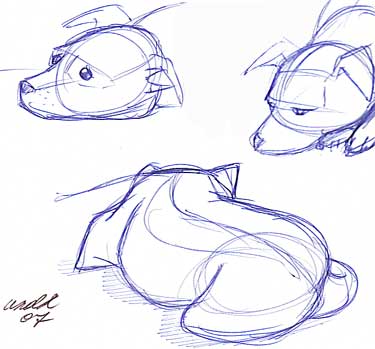
Sketch of the Day:
Random older dog sketches.
Once again, it probably looks like I am making this plot point up, but I promise you I am not. It was probably unintentional, given the length of time given in making an animated film even one as half-assed as this, but intentional or not, we have here a post-9/11 Disney movie.
And it is a God-damned direct-to-video "Peter Pan" sequel that was clearly put into theaters at the last minute as a shameless cash grab.
I'll admit the setup, the very idea of setting a sequel to "Peter Pan" in the middle of World War Two (by the way, hell of a context for kids to learn about these events for the first time) is fascinating, and it might have actually worked out had they spent more effort on it. Unfortunately, as I mentioned, this film is half-assed. Every single thing about it is half-assed. The animation is far worse in quality than "Pooh's Grand Adventure" (for the record, the two films were done in different Disney studios. Moment of silence for the international branches of Disney Animation.) The songs are terrible and feel even more like an obligation. And there is some use of fully-rendered computer animation that... Conspicuous CGI doesn't even cover it.
And then, there's the main conflict of the movie. It's not the fact that Captain Hook is back and has traveled to our world to kidnap a descendent of one of the characters in the original story and now Peter has to save them and blah. (There's a lot of originality in these "Peter Pan" sequels isn't there?) Nope, it's a conflict that's alarmingly common in children's fiction and that drives me up the God damned wall.
In this film there are two opponents: faith and skepticism. Jane, who -just as a reminder- is living during a time period when her home was likely to be bombed into oblivion at any second, is skeptical and realistic about her situation. And according to arguable insane troll logic of this film, if you are a person who is skeptical and realistic about anything, you are ALSO a person who believes in nothing. So Jane doesn't believe in Peter Pan or magic or wonder or childhood whimsy or fun or getting any sort of enjoyment out of life. But her mother and little brother Believe! Oh, wouldn't it be better for Jane if she just Believed! If she could stop worrying so much about her family dying horribly at any moment and live in a wonderful world of make-believe and denial and... yeah, if you can't tell by now, this whole subplot is f***ing ridiculous. It's handled as badly and clumsy as that one episode of "Friendship is Magic" that p**sed everyone off and that I am probably going to quickly and strongly regret ever bringing up. It's that ridiculous.
As an aside, it should be noted that at least neither "Return to Neverland" nor "Feeling Pinkie Keen" handle this theme in a way that is as nauseatingly bad, deeply insulting, and even downright dangerously as "Tinkerbell and the Great Fairy Rescue" does. I'm not covering the Tinkerbell movies here, even though up until the third one they were much better than I expected. But in case you are blissfully unaware, in "Great Fairy Rescue", the hero is a little girl who believes in Fairies (who are absolutely real in the world of the film) and her main antagonist is her own father, who is -pause for drama- a skeptical biologist. You cannot imagine how much I would love to be making all of this up. Like all the mean old adults in this movie, he's under the assumption that that Fairies aren't real, so he flat-out tells his daughter to stop "studying" the Fairies and even throws her Sketchbook away when he sees that she's filled it with Fairies. Because if there is anything scientists are known for, it's that they will completely discourage their own children from using their imagination or engaging in creative play of any kind because scientists themselves suffer from a complete and utter lack of imagination. And as we all know, all scientists operate under the assumption that they already know everything there is to know about the world and that there is absolutely nothing new at all to learn anywhere ever. That's totally how science works. And when confronted with firsthand evidence or one living specimen of a creature that for centuries was assumed to be extinct or mythical, they will treat it as cruelly as humanly possible. Lastly, in this day and age, we very very definitely need a movie for very young girls where science is bad and wrong. Yeah, f*** you very much, writers of "Tinkerbell and the Great Fairy Rescue."
I should also note that I have a lot of problems with the opposite version of this "skepticism is bad and so you should believe in everything" theme, as it so often and easily warps into "using your imagination is bad and so you should be uncreative and boring".
There's also a weird spit motif going on in "Return to Neverland", but that's neither here nor there. The -sigh- Indian Camp makes an appearance in this film, but it is unpopulated, which is actually more uncomfortable than not addressing it at all. And after a while, since they are onscreen more prominently here, the slow realization that the Lost Boys are essentially running around in fursuits gets... awkward.
But not as awkward as this thing that shows up in the end credits, which is as good a note to end on as any:

I'm sure they're so happy to have inspired this.
-----
Sketch of the Day:
Random older dog sketches.

Subscribe to:
Posts (Atom)